What does a typical daycare day look like for infants, toddlers and preschoolers?
A daycare schedule offers helpful anchors without locking in the day. See sample routines for infants, toddlers and preschoolers that respect their pace.
The short answer
There is no single daily schedule that works for every group. A schedule is mainly there to provide familiar anchors: arrival, play, meals, care routines, rest, outdoor time and departure. In Quebec, the Ministry says the daily schedule should remain flexible, make room for free play and adapt to children’s pace. For infants, plan a separate schedule that takes their individual rhythms into account.
The schedules below are planning examples, not prescribed times. They assume a childcare day of about 7 a.m. to 6 p.m. Adjust them to your centre’s opening hours, educational program, space and the group’s actual needs.
What should guide the schedule?
In Quebec, the Regulation respecting childcare centres includes a sample daily schedule among the elements submitted for the application of the educational program. The schedule must include outdoor time and the times for meals and snacks. Section 114 provides for at least 60 minutes outdoors each day, unless conditions could compromise children’s health, safety or well-being.
The Ministry of Families also recommends including key parts of the day: arrival, meals and snacks, tidying up, transitions, naps, departure and outdoor time. Its guidance on organizing a childcare service says to consider children’s immediate needs, available resources and the seasons. For infants, it recommends a separate sample schedule organized around each child’s individual rhythm.
In practice, build the day around steady anchors without turning every block into a staff-led activity. Arrival, meals, hygiene, rest and tidying up are all part of children’s learning experiences. A brief transition announced in advance, a clean-up song or a small choice between two activities can help the group move to what comes next.
For meals, Quebec’s regulation requires food provided by the centre to be consistent with Canada’s Food Guide. The Guide is intended for people aged 2 and older, so do not treat it as a universal feeding schedule for infants. For older children, keep meal and snack times predictable and follow your centre’s menu and instructions. Consult Canada’s Food Guide and your centre’s food policy.
Sample schedules by age group
These examples show one possible sequence. Shift the times to reflect arrivals, how your centre operates and the group’s routines.
Infants: a flexible sequence
For infants, think in sequences rather than one long, shared group schedule. The Ministry recommends that the day include care and hygiene, feeding, stimulation, rest and outdoor time, according to each infant’s individual rhythm.
- 7 to 9 a.m.: Individual welcome, a brief exchange with the parent, quiet floor play and care as needed.
- Throughout the morning: Feeding according to the arrangements made with the family; awake periods, exploration of simple materials, songs or a walk. Offer rest when the infant needs it rather than waiting for the whole group to lie down.
- Around lunchtime: Meals for infants eating solid foods, care and rest according to their usual cues. Infants who are awake can explore in a suitable, supervised space.
- Afternoon: More play and rest periods, individual interaction, a snack or feeding according to the agreed instructions, and outdoor time if conditions allow.
- Late afternoon: Quiet play, care routines, getting ready for departure and sharing useful information with the parent.
One infant may be asleep while another is playing or eating. Organize the room and staff responsibilities so the team can respond to individual needs while maintaining supervision of the group.
Toddlers: familiar anchors
For a toddler group, you can alternate free play, short group moments, outdoor time and routines. For example:
- 7 to 8:30 a.m.: Staggered arrivals and free play.
- 8:30 to 9:30 a.m.: Snack, hygiene and movement play or exploration.
- 9:30 to 11 a.m.: Outdoor play or a discovery activity, with the transition announced ahead of time.
- 11 a.m. to 12:30 p.m.: Handwashing, lunch and getting ready for rest.
- 12:30 to 2:30 p.m.: Rest or quiet time, according to the group’s needs and your centre’s organization.
- 2:30 to 4 p.m.: Gradual wake-up, snack, free play or an outdoor activity.
- 4 to 6 p.m.: End-of-day play, departures and conversations with families.
These time blocks are not required durations. If getting dressed takes longer or children are deeply engaged in play, adjust the transition instead of rushing everyone to meet an arbitrary time.
Preschoolers: more choice and projects
For preschoolers, keep the same daily anchors but leave more room for extended play, projects and choice. A morning might combine arrival and free play, snack, an activity offered by the early childhood educator, outdoor play and lunch. After lunch, plan for a quiet period. In the afternoon, alternate free play, exploration, outdoor time and getting ready for departure.
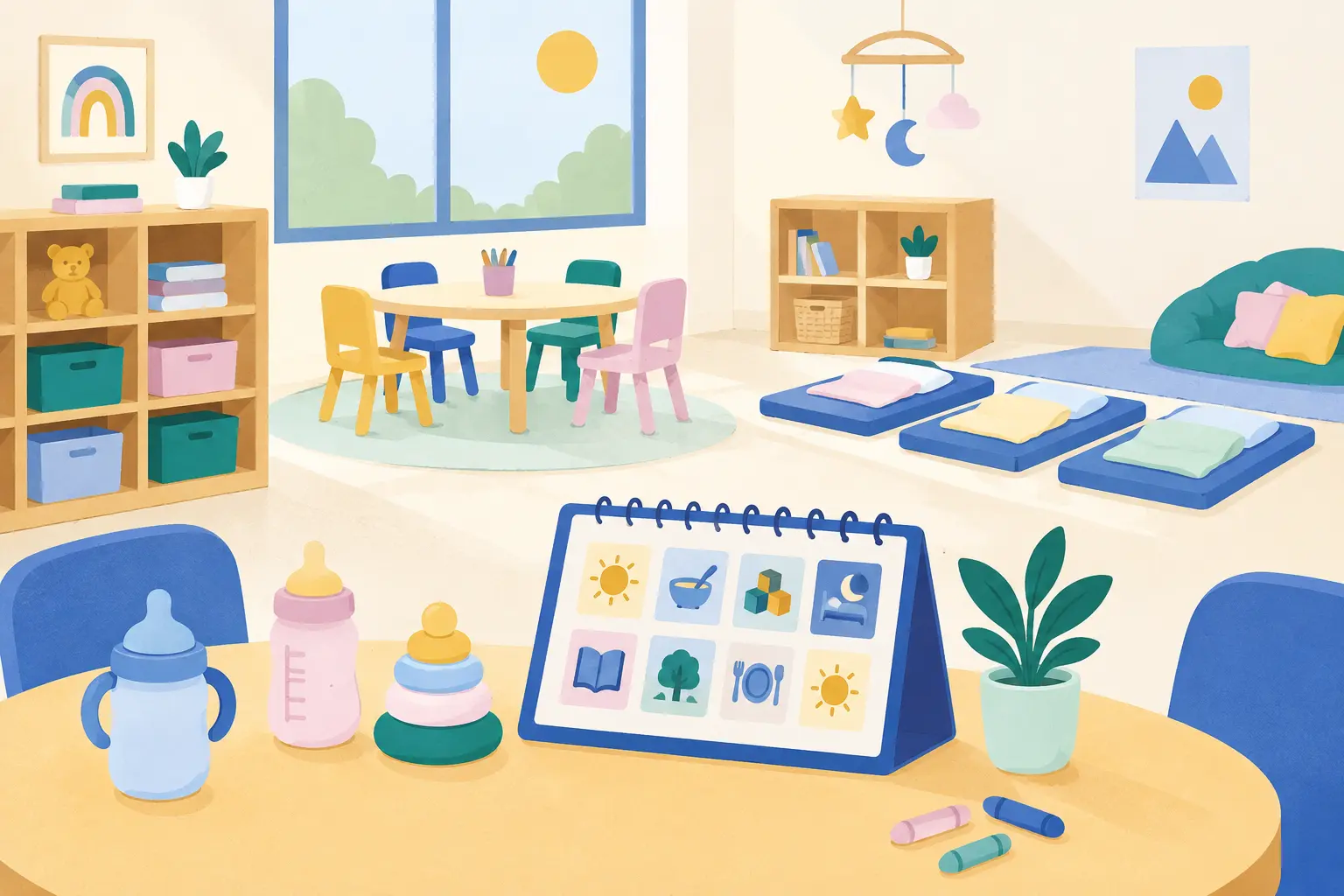
Post the sequence with pictures or simple words. You might say, “After we tidy up, we’ll put on our boots and go outside.” Children can see what comes next without the schedule setting the same pace for every child’s play or rest.
Adjust, display and communicate
A useful schedule is clear enough for the team to follow and flexible enough to match the day as it unfolds. When reviewing it, ask:
- Are arrival, meals, rest, outdoor time and departure easy to see?
- Is there enough time in transitions for care routines, tidying up and getting dressed?
- Do infants have a schedule that respects their individual rhythms?
- Is there meaningful time for free play and experiences both indoors and outdoors?
- Do families know which parts of the routine are consistent and how the team adapts them?
In Quebec, the outdoor-time requirement is at least 60 minutes per day, subject to the exception in the regulation. Ontario’s rule is different: under the Child Care and Early Years Act, 2014 regulation, children receiving care for six hours or more per day must have at least two hours of outdoor play, weather permitting, except where the regulation provides otherwise. For the toddler and preschool groups covered by the regulation, it also provides for a rest period of no more than two hours, while allowing children to sleep, rest or take part in quiet activities according to their needs. Always check the legislation that applies in your province; the requirements are not interchangeable.
Finally, communicate significant changes to the team and families. A simple message can be enough: “We’re moving outdoor time to the afternoon today because of the weather; the rest of the routine will stay the same.” If a child seems unwell or the team is concerned about their condition, follow your centre’s policy, notify the parent and contact Info-Santé 811 in Quebec if needed. In an emergency, call 911.
Frequently asked questions
Is there one mandatory schedule for every childcare centre?
No. In Quebec, a centre must have a sample daily schedule, but it must also adapt the day to children’s needs, available resources and the seasons.
Do all infants have to nap at the same time?
No. Quebec’s Ministry recommends a separate schedule for infants that respects each child’s individual rhythm, including for rest and feeding.
How much outdoor time is required in Quebec?
The regulation provides for at least 60 minutes outdoors each day, unless conditions could compromise children’s health, safety or well-being.
Is the rule the same in Ontario?
No. In Ontario, the regulation provides for at least two hours of outdoor play each day for children in care for six hours or more, weather permitting, with some exceptions.
What should we do if a child seems unwell during the day?
Follow your centre’s policy, contact the parent and, if needed, call Info-Santé 811 in Quebec or your local health advice line. In an emergency, call 911.
This article is for information; it does not replace advice from a health professional. In Québec, call Info-Santé 811 when in doubt (elsewhere in Canada, your provincial health line). In an emergency, call 911.
Sources
- Programme éducatif en service de garde (in French), Ministère de la Famille, Québec.ca
- Accueillir la petite enfance — Programme éducatif pour les services de garde éducatifs à l’enfance (in French), Ministère de la Famille
- Canada’s food guide, Santé Canada
- O. Reg. 137/15: General — Child Care and Early Years Act, 2014, Gouvernement de l’Ontario
- Child Care and Early Years Act, 2014, Gouvernement de l’Ontario