Month by month
9 month old milestones
At nine months, your baby sits alone, looks for a hidden toy and can be wary of strangers. Here are the milestones most babies reach by this age, play ideas and when to ask for advice.
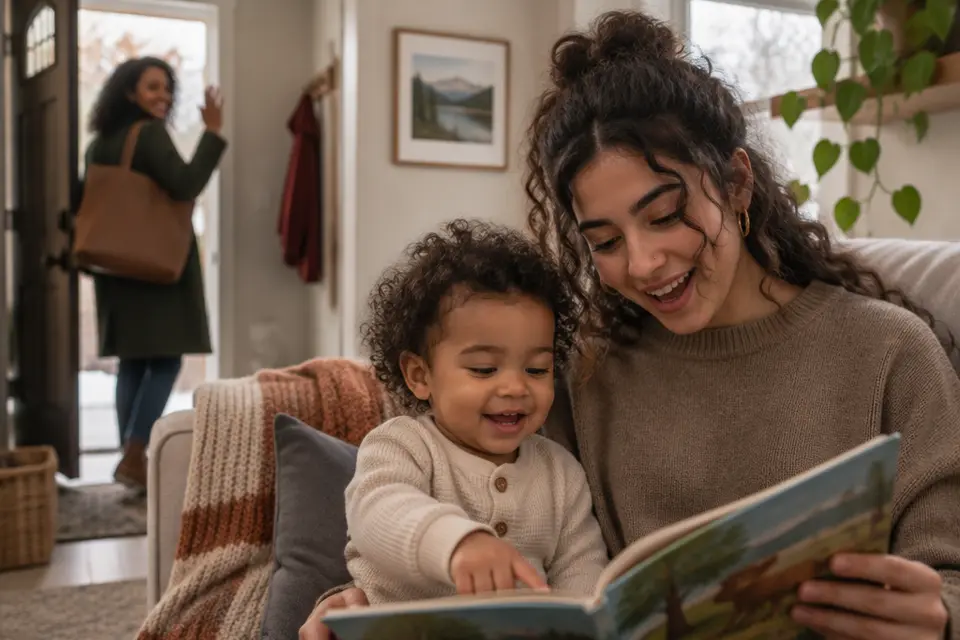
What does a 9 month old do?
Nine months is a checkpoint on the CDC “Learn the Signs. Act Early” checklist. Your baby now understands that a hidden object still exists, which changes how they play and how they react when you leave. They express themselves with varied sounds and gestures and move more independently.
Movement at 9 months
They sit without support and get into a sitting position on their own. Hands become more precise: passing objects from hand to hand and raking food toward themselves with the fingers before mastering the pincer grasp.
- Sits without support.
- Gets to a sitting position alone.
- Moves things from one hand to the other.
- Uses fingers to rake food toward themselves.
Language and communication
They make lots of different sounds like “mamamama” and “babababa” and lift their arms to be picked up. They look when you call their name.
- Makes lots of different sounds (“mamamama”, “babababa”).
- Lifts arms up to be picked up.
- Looks when you call their name.
Feelings and learning
Your baby may be shy, clingy or fearful around strangers and react when you leave: looking, reaching for you or crying. They show several facial expressions (happy, sad, angry, surprised) and smile or laugh at peek-a-boo. They look for objects dropped out of sight and bang two things together.
- Is shy, clingy or fearful around strangers.
- Shows several facial expressions.
- Reacts when you leave.
- Smiles or laughs at peek-a-boo.
- Looks for objects dropped out of sight.
- Bangs two things together.
How to play with a 9 month old
Hide-and-seek and cause-and-effect games are perfect at this age.
- Hide a toy under a cloth while they watch.
- Sit facing them and roll a ball between your legs.
- Give them a spoon and a bowl to bang.
- Read books and let them point to pictures.
- Wave bye-bye and invite them to copy you.
When should you talk to a professional?
In Québec, Agir tôt lets you request a screening at the CLSC without a referral. According to the INSPQ, a baby who does not turn toward sounds or reacts little to noise should be seen as soon as possible.
Every child develops at their own pace, and these milestones describe what about three in four children do by this age. If your child is not doing one or more of them yet, loses a skill they had, or something worries you, don’t wait: talk to their doctor or nurse. In Québec, your CLSC access desk can also register your child for an Agir tôt screening without a referral, and Info-Santé 811 answers questions. For a baby born preterm, use the corrected age.
What is worth noting in Maliah
At nine months, many babies wake more at night, along with separation anxiety. Logging wakings for a few nights in a row helps you see clearly.
In Maliah, feeds, sleep and diapers are logged in two taps or by voice, and the whole family sees the same entries, each with its author and time. Before an appointment, the summary for the doctor gathers what was noted since the last visit.
Frequently asked questions
What should a 9 month old be doing?
According to the CDC, most nine-month-olds sit alone, get into sitting on their own, babble (“mamama”), lift their arms to be picked up, look for hidden objects and may be wary of strangers.
My 9 month old isn’t crawling. Should I worry?
Crawling is not on the CDC checklist, because some babies get around in other ways. According to the INSPQ, crawling on hands and knees usually develops between nine and twelve months. If you are worried, talk to the doctor.
Why does my 9 month old cry when I leave?
Separation anxiety begins around eight or nine months, according to the INSPQ. Your baby understands you exist out of sight, but not yet that you will come back.
Does a 9 month old say words?
At nine months, babies mostly babble repeated syllables. First words with meaning usually appear around twelve months.
Read next
- 8 month old milestones
- 10 month old milestones
- Separation anxiety in babies
- When do babies sit up on their own?
Related free tools
Other guides
Sources : CDC, Learn the Signs. Act Early : listes de repères (révision 2022) · CDC : 2 months · CDC : 4 months · CDC : 6 months · CDC : 9 months · CDC : 1 year · CDC : 15 months · CDC : 18 months · CDC : 2 years · CDC : 3 years · CDC : 4 years · CDC : 5 years · INSPQ, Mieux vivre : Étapes du développement de l’enfant · INSPQ, Mieux vivre : Activités pour soutenir le développement de l’enfant · INSPQ, Mieux vivre : Vous avez des questions sur le développement de votre enfant ? · INSPQ, Mieux vivre : Apprentissage de la propreté · INSPQ, Mieux vivre : Dents de bébé · INSPQ, Mieux vivre : Prévention de la tête plate · Société canadienne de pédiatrie, Soins de nos enfants : Toilet learning · Santé Canada : produits de consommation interdits au Canada (dont les marchettes pour bébés) · Québec.ca : Dépistage de la surdité chez les nouveau-nés
Worried about your child’s health or your pregnancy? In Québec, Info-Santé 811 answers day and night; elsewhere, call your local health line. In an emergency, call 911. This article is for information; it does not replace advice from a health professional. In Québec, call Info-Santé 811 when in doubt (elsewhere in Canada, your provincial health line). In an emergency, call 911. Updated on November 7, 2026.