Breastfeeding and bottles
Starting solids: when and how to begin with your baby
Around six months, milk is no longer enough and babies discover food. When to start, what to offer first, how fast, purées or pieces: here are the essentials from Health Canada, the Canadian Paediatric Society and the INSPQ.
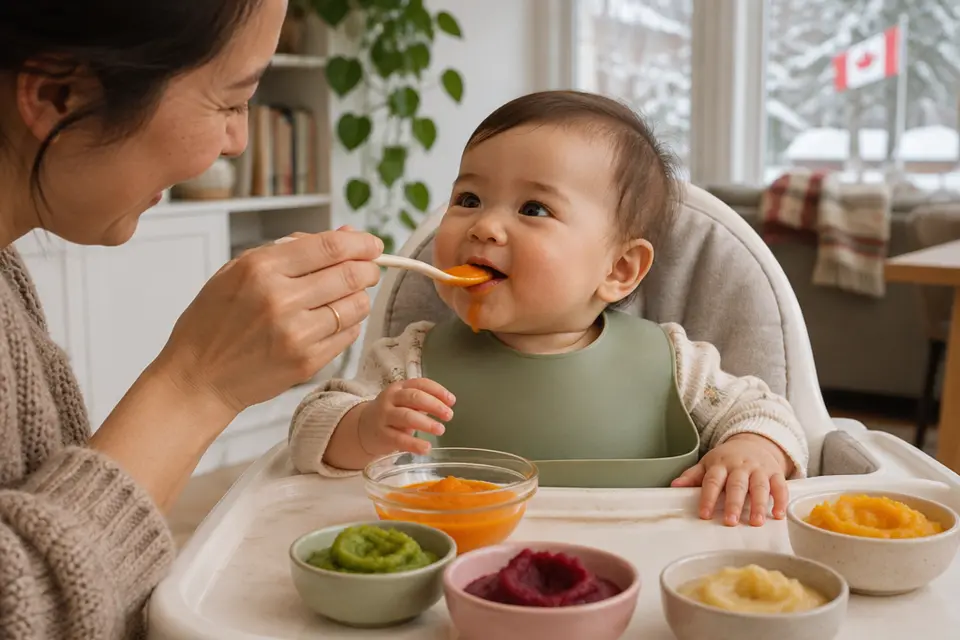
When should babies start solids?
Around six months, according to the INSPQ and Health Canada. Before four months, the digestive system isn’t developed enough; too late, babies risk low iron and a harder time adjusting to textures. Your baby is ready when they show several signs together:
- sits without support in a high chair;
- has good head control and can turn away to refuse;
- tries to bring food to their mouth;
- no longer pushes food out with the tongue every time.
- For a premature baby, use corrected age.
What foods should come first?
Iron-rich foods, offered at least twice a day: meat, poultry, fish, egg, tofu, well-cooked legumes, iron-fortified infant cereal. After that, order matters little: vegetables, fruit, grain products, yogurt and cheese join between 6 and 9 months. The INSPQ says there is no need to wait several days between new foods, and a refused food can be tried again ten times or more.
What about allergens?
Common allergenic foods, such as egg, peanut, tree nuts, fish, shellfish, wheat, soy, sesame and dairy, are introduced alongside other foods, without delay. The Canadian Paediatric Society suggests introducing one new allergen at a time and, once tolerated, continuing to offer it a few times a week.
Purées, pieces or both?
You can start with spoon-fed purées and gradually thicken them, or offer soft pieces your baby picks up from six months (baby-led weaning). The order of foods is the same for both methods. Health Canada recommends offering lumpy textures no later than nine months, and the INSPQ aims for varied textures by about one year.
What to avoid
A few simple rules keep babies safe:
- no honey before one year (botulism risk, according to Health Canada);
- no added salt or sugar before at least one year;
- no cow’s milk to drink before 9 to 12 months;
- no hard, small, round or sticky foods without modifying them, until age four;
- no cereal in the bottle; babies always eat seated and supervised by an adult.
What is worth noting in Maliah
In the first weeks of solids, the list of foods your baby has tasted builds itself, meal after meal. In Maliah, a feed, a meal or a diaper is logged in two taps or by voice, with the time and the name of whoever logged it. The whole family sees the same log, and a summary of the last few days is ready for the visit with the doctor or nurse.
Frequently asked questions
At what age should babies start solids?
Around six months, when your baby shows readiness, according to the INSPQ and Health Canada. Never before four months.
What is the best first food for a baby?
An iron-rich food: meat, fish, egg, tofu, legumes or iron-fortified infant cereal.
How many new foods per day?
The INSPQ says there is no need to wait several days between new foods; for allergens, one new one at a time.
Should my baby drink less milk when starting solids?
No, not at first. Keep breastfeeding as often as they want or keep offering formula; milk gradually decreases around 8 or 9 months.
Read next
- 6 month old feeding schedule: how to start solid foods
- Baby-led weaning: how to start safely, step by step
- Baby food purées: where to start and how to move on
- Introducing allergens to your baby: the list and how to start
Related free tools
Other guides
Sources : INSPQ : Mieux vivre avec notre enfant de la grossesse à deux ans (guide 2026) · INSPQ, Mieux vivre : Quand introduire les aliments ? · INSPQ, Mieux vivre : Comment introduire les aliments ? · INSPQ, Mieux vivre : Diversification alimentaire menée par l’enfant (DME) · INSPQ, Mieux vivre : Risques d’étouffement, à surveiller jusqu’à 4 ans · INSPQ, Mieux vivre : Allergies alimentaires chez l’enfant · INSPQ, Mieux vivre : Bases d’une tétée · INSPQ, Mieux vivre : Manipulation du lait exprimé · INSPQ, Mieux vivre : Tiédir le lait · INSPQ, Mieux vivre : Sevrage de l’allaitement · INSPQ, Mieux vivre : Rots, régurgitations, hoquet et gaz · Santé Canada : Nutrition du nourrisson né à terme et en santé, de 6 à 24 mois · Santé Canada : Nutrition du nourrisson né à terme et en santé, de la naissance à 6 mois · Santé Canada : Allergies alimentaires (allergènes prioritaires) · Santé Canada : Le mercure dans le poisson · Société canadienne de pédiatrie (Soins de nos enfants) : Nourrir votre bébé pendant la première année · Guide alimentaire canadien · Organisation mondiale de la santé : Allaitement
Worried about your child’s health or your pregnancy? In Québec, Info-Santé 811 answers day and night; elsewhere, call your local health line. In an emergency, call 911. This article is for information; it does not replace advice from a health professional. In Québec, call Info-Santé 811 when in doubt (elsewhere in Canada, your provincial health line). In an emergency, call 911. Updated on November 7, 2026.