When can babies eat…
When can babies eat avocado, and how should you serve it?
Soft and easy to mash, avocado is often one of the first fruits offered around six months, as a purée or in strips. Here is how to prepare it by age and how to pair it with iron-rich foods.
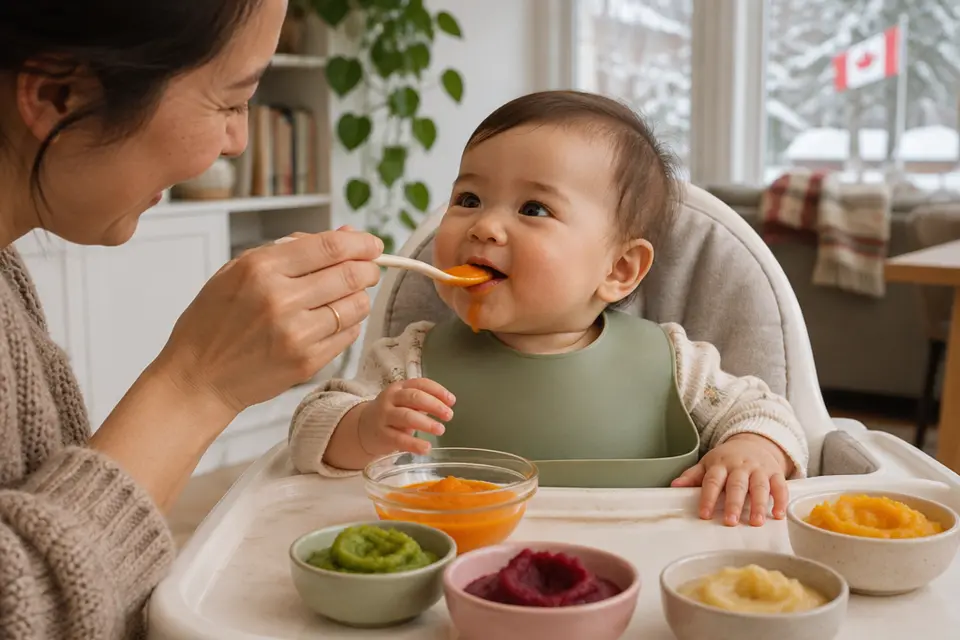
At what age can babies have avocado?
As soon as your baby is ready for solids, around six months. Health Canada suggests introducing vegetables and fruit between 6 and 9 months, along with iron-rich foods, which remain the priority. Ripe avocado is naturally soft: it works for purées as well as finger food.
Why is avocado a good choice?
Avocado provides good-quality fat and a creamy texture many babies accept easily. It isn’t high in iron, though: serve it with an iron-rich food such as lentils, shredded chicken or iron-fortified infant cereal. No salt or sugar needed.
How to prepare avocado by age
Choose a ripe avocado that gives slightly under gentle pressure.
- Around 6 months: fork-mashed avocado, alone or mixed with puréed legumes or chicken.
- Around 6 months, baby-led: thick strips the size of an adult finger; rolling them in infant cereal makes them easier to hold.
- 9 to 12 months: small cubes picked up with a pincer grasp, homemade guacamole with no salt or chili.
- Remove pit and skin; never leave your baby alone while eating.
What to watch for the first time
Avocado is not one of Canada’s priority food allergens and reactions are uncommon. As with any new food, watch your baby after the meal. According to the INSPQ, call 911 if your child has red patches on the skin with swelling of the lips or tongue, difficulty breathing, sudden vomiting or a rapid change in general condition. For other questions, talk to your doctor or a health line (811 in Québec).
What is worth noting in Maliah
Logging what goes with the avocado on the plate helps check that an iron-rich food is offered twice a day. In Maliah, a feed, a meal or a diaper is logged in two taps or by voice, with the time and the name of whoever logged it. The whole family sees the same log, and a summary of the last few days is ready for the visit with the doctor or nurse.
Frequently asked questions
Can a 6 month old eat avocado?
Yes. Ripe, mashed or in thick strips, it’s a handy first food.
Can babies eat avocado every day?
Yes, as part of a varied diet. Remember to pair it with iron-rich foods.
How do I stop avocado slipping out of my baby’s hands?
Rolling strips in infant cereal or leaving a little skin at one end helps your baby hold them.
How do I know an avocado is ripe enough for my baby?
It gives under light finger pressure and mashes easily with a fork. A firm avocado is harder for a young baby to chew and swallow.
Read next
- When can babies eat bananas, and how should you cut them?
- Baby-led weaning: how to start safely, step by step
- Baby food purées: where to start and how to move on
- 6 month old feeding schedule: how to start solid foods
Related free tools
Other guides
Sources : INSPQ : Mieux vivre avec notre enfant de la grossesse à deux ans (guide 2026) · INSPQ, Mieux vivre : Quand introduire les aliments ? · INSPQ, Mieux vivre : Comment introduire les aliments ? · INSPQ, Mieux vivre : Diversification alimentaire menée par l’enfant (DME) · INSPQ, Mieux vivre : Risques d’étouffement, à surveiller jusqu’à 4 ans · INSPQ, Mieux vivre : Allergies alimentaires chez l’enfant · INSPQ, Mieux vivre : Bases d’une tétée · INSPQ, Mieux vivre : Manipulation du lait exprimé · INSPQ, Mieux vivre : Tiédir le lait · INSPQ, Mieux vivre : Sevrage de l’allaitement · INSPQ, Mieux vivre : Rots, régurgitations, hoquet et gaz · Santé Canada : Nutrition du nourrisson né à terme et en santé, de 6 à 24 mois · Santé Canada : Nutrition du nourrisson né à terme et en santé, de la naissance à 6 mois · Santé Canada : Allergies alimentaires (allergènes prioritaires) · Santé Canada : Le mercure dans le poisson · Société canadienne de pédiatrie (Soins de nos enfants) : Nourrir votre bébé pendant la première année · Guide alimentaire canadien · Organisation mondiale de la santé : Allaitement
Worried about your child’s health or your pregnancy? In Québec, Info-Santé 811 answers day and night; elsewhere, call your local health line. In an emergency, call 911. This article is for information; it does not replace advice from a health professional. In Québec, call Info-Santé 811 when in doubt (elsewhere in Canada, your provincial health line). In an emergency, call 911. Updated on November 7, 2026.