When can babies eat…
When can babies eat cheese, and which ones are best?
Cheese can be introduced between six and nine months, well before cow’s milk to drink. Here is which cheeses to choose, how to cut them to prevent choking and why dairy is an allergen to offer early, according to Health Canada and the INSPQ.
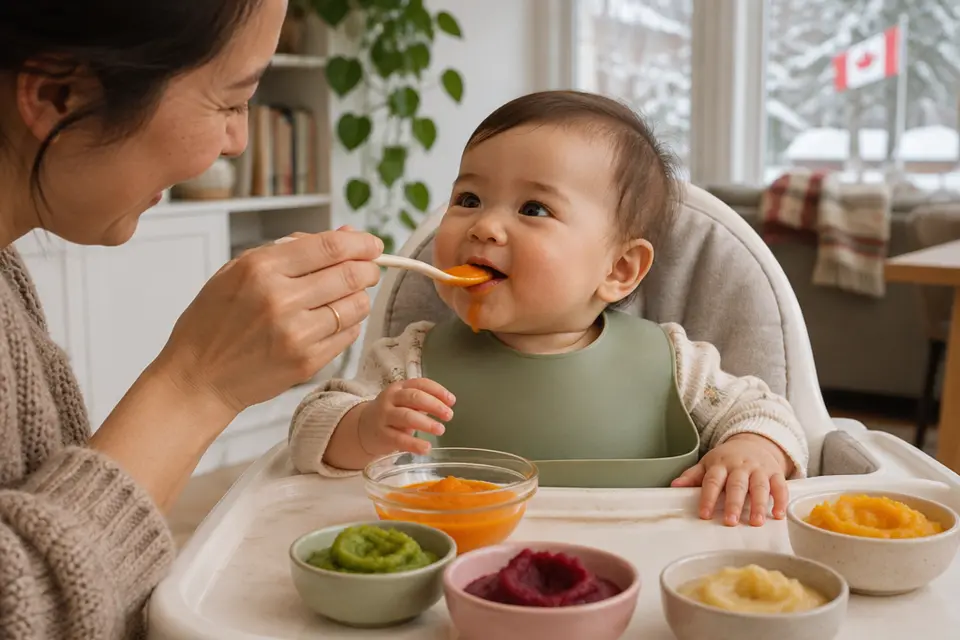
At what age can babies eat cheese?
Health Canada says dairy foods such as cheese and yogurt can be introduced between 6 and 9 months, alongside iron-rich foods. This is different from cow’s milk to drink, which waits until 9 to 12 months. Milk is also one of Canada’s priority food allergens, which the INSPQ recommends introducing without delay.
Which cheeses are best for babies?
Choose cheeses made from pasteurized milk. Raw-milk products carry a higher risk of bacteria for young children, according to Health Canada.
- Mild pasteurized cheeses: mild cheddar, mozzarella, Swiss, havarti, ricotta, cottage cheese.
- Lower-salt cheeses when possible: babies don’t need added salt.
- Avoid: raw-milk cheeses and, for young children, large amounts of very salty processed cheese slices.
How to cut cheese by age
Hard cheese cubes and thick sticks can block the throat. Match the shape to your baby’s age.
- Around 6 months: finely grated cheese on vegetables or pasta, ricotta or cottage cheese mixed into a purée.
- Around 6 months, baby-led: thin slices or cheese melted on a strip of toast.
- 9 to 12 months: small cubes of soft cheese, grated cheese picked up with fingers.
- Until age 4: avoid big hard cubes; prefer thin slices or grated cheese.
What reaction signs should I watch for?
After offering a dairy food for the first time, watch your baby over the next few hours. According to the INSPQ, a fast reaction usually happens within minutes to two hours after the food. Call 911 if your child has red patches on the skin and one or more of these signs:
- a rapid change in general condition: irritability, drowsiness, loss of consciousness;
- swelling of the lips or tongue;
- difficulty breathing;
- sudden vomiting.
- For a milder reaction, stop the food and talk to your doctor, or call a health line (Info-Santé 811 in Québec).
What is worth noting in Maliah
Dairy foods offered, their form and how they were tolerated are easy to find for the doctor’s visit. In Maliah, a feed, a meal or a diaper is logged in two taps or by voice, with the time and the name of whoever logged it. The whole family sees the same log, and a summary of the last few days is ready for the visit with the doctor or nurse.
Frequently asked questions
Can a 6 month old eat cheese?
Yes, if ready for solids. Health Canada places cheese and yogurt between 6 and 9 months.
Is raw-milk cheese OK for babies?
No, raw-milk cheeses should be avoided for young children. Choose pasteurized cheeses.
Why cheese before cow’s milk?
Cheese adds to meals without replacing breast milk or formula. Cow’s milk to drink waits until 9 to 12 months.
Read next
- When can babies eat yogurt, and which one should you choose?
- When can babies have cow’s milk?
- Introducing allergens to your baby: the list and how to start
- 9 to 11 month old feeding schedule: meals, snacks and milk
Related free tools
Other guides
Sources : INSPQ : Mieux vivre avec notre enfant de la grossesse à deux ans (guide 2026) · INSPQ, Mieux vivre : Quand introduire les aliments ? · INSPQ, Mieux vivre : Comment introduire les aliments ? · INSPQ, Mieux vivre : Diversification alimentaire menée par l’enfant (DME) · INSPQ, Mieux vivre : Risques d’étouffement, à surveiller jusqu’à 4 ans · INSPQ, Mieux vivre : Allergies alimentaires chez l’enfant · INSPQ, Mieux vivre : Bases d’une tétée · INSPQ, Mieux vivre : Manipulation du lait exprimé · INSPQ, Mieux vivre : Tiédir le lait · INSPQ, Mieux vivre : Sevrage de l’allaitement · INSPQ, Mieux vivre : Rots, régurgitations, hoquet et gaz · Santé Canada : Nutrition du nourrisson né à terme et en santé, de 6 à 24 mois · Santé Canada : Nutrition du nourrisson né à terme et en santé, de la naissance à 6 mois · Santé Canada : Allergies alimentaires (allergènes prioritaires) · Santé Canada : Le mercure dans le poisson · Société canadienne de pédiatrie (Soins de nos enfants) : Nourrir votre bébé pendant la première année · Guide alimentaire canadien · Organisation mondiale de la santé : Allaitement
Worried about your child’s health or your pregnancy? In Québec, Info-Santé 811 answers day and night; elsewhere, call your local health line. In an emergency, call 911. This article is for information; it does not replace advice from a health professional. In Québec, call Info-Santé 811 when in doubt (elsewhere in Canada, your provincial health line). In an emergency, call 911. Updated on November 7, 2026.