Sleep topics
Bedtime routine for babies and toddlers: simple, short and repeated
An evening routine helps a baby understand that sleep is coming. The INSPQ and the Canadian Paediatric Society describe what goes into one; here is how to build it by age, with an example to adapt.
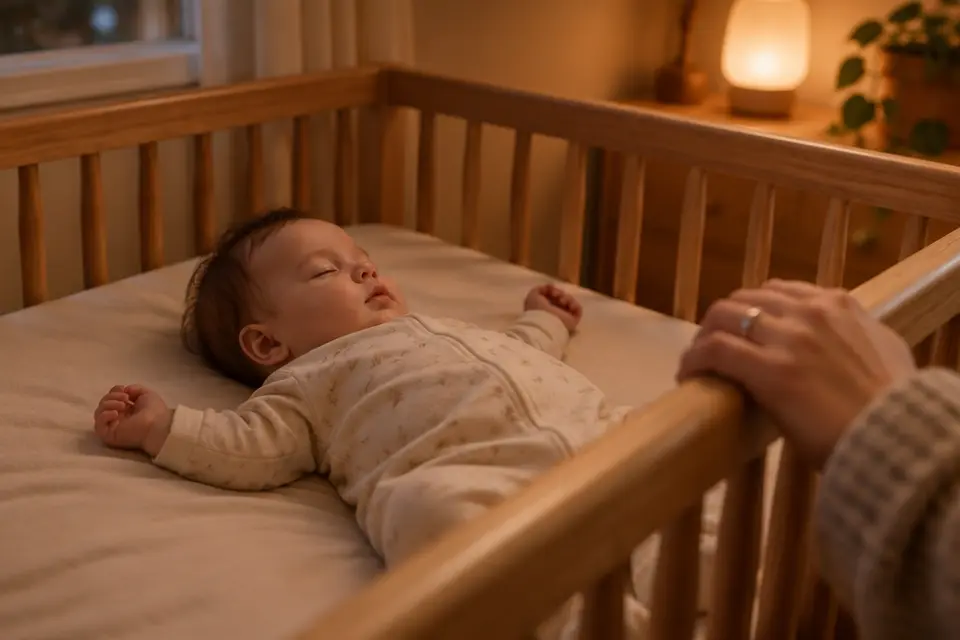
Why does a bedtime routine help?
According to the INSPQ, a consistent routine repeated every evening signals to a baby that sleep is coming. The Canadian Paediatric Society also stresses regularity: the same sequence, at about the same time, reassures and prepares for sleep.
There is no minimum age: you can start with a newborn with a few simple steps, then add to the routine as they grow.
What goes into the routine?
A few examples from the INSPQ and the CPS:
- a bath, or a quick wash-up on other nights;
- quiet play, a song or soft music;
- a story: the CPS often sums it up as “bath, book, bed”;
- the last feed, then brushing teeth once they are in;
- a night-light in the hallway and a door left ajar, the INSPQ suggests;
- for naps, a short version: a cuddle and a short story in a dark room (CPS).
Example evening routine, to adapt
An example only, to adapt to your family: the whole thing often takes around 20 to 30 minutes, and what matters is the same order every night.
- Dim lights and quiet play, no screens.
- Bath or wash-up, pyjamas, clean diaper.
- Feed, then teeth brushed if there are any.
- One or two stories, always the same number.
- A song or a ritual phrase, then bed in their own crib, on the back for a baby.
The routine by age
For babies, keep the routine short. Night feeds stay calm and in dim light, without restarting the routine. From about 4 months, the American Academy of Pediatrics suggests putting your baby down drowsy but awake, if you want them to learn to fall asleep alone.
For toddlers, the CPS suggests winding down for about 30 minutes before bed (stories, quiet play). The INSPQ speaks of gentle firmness: a consistent routine, held calmly, reassures a child who cries at bedtime. For preschoolers, the CPS advises setting the number of stories in advance and avoiding screens before bed.
When the routine is not enough
If your child has no health problem and sleeps poorly, the INSPQ suggests reviewing the routine to make sure it supports sleep. If you cannot set up a routine, or if wakings continue despite one and worry you, talk to a health professional or call your health line (811 in Québec).
What is worth logging in Maliah
In Maliah, a sleep is logged with a tap or by voice, with the time and the name of whoever logged it. Your partner, the grandparents or the babysitter see the last sleep and the last feed without texting, and the summary over a few weeks can be shown to the doctor or nurse. From what the family logs, Maliah suggests a routine you can adjust and share with the babysitter or grandparents, so your child finds the same order everywhere. The site’s “Bedtime routine” tool also helps you build one.
Frequently asked questions
When should I start a bedtime routine?
From the first weeks, with a few simple steps. According to the INSPQ, it is the repetition every evening that ends up signalling sleep to the baby.
How long should a bedtime routine take?
Official sources do not set a length. For toddlers, the Canadian Paediatric Society mentions about 30 minutes of winding down before bed.
What if my baby falls asleep during the feed in the routine?
It is common. If you want them to learn to fall asleep alone, the American Academy of Pediatrics suggests putting them down drowsy but still awake from about 4 months; otherwise, nothing forces you to change.
Should screens be part of the routine?
No: the CPS advises avoiding screens before bed.
Read next
- 2 year old sleep schedule
- 7 month old sleep schedule
- When do babies sleep through the night, and what does it mean?
Related free tools
Other guides
Sources : INSPQ, Mieux vivre : Dormir en sécurité · INSPQ, Mieux vivre : Mort subite du nourrisson · INSPQ, Mieux vivre : Prévention de la tête plate · INSPQ, Mieux vivre : Sommeil dans les premières semaines de vie · INSPQ, Mieux vivre : Sommeil autour de l’âge de 4 mois · INSPQ, Mieux vivre : Sommeil après 6 mois · INSPQ, Mieux vivre : Sommeil entre 1 et 2 ans · Société canadienne de pédiatrie, Caring for Kids : Healthy sleep for your baby and child · Directives canadiennes en matière de mouvement sur 24 heures pour la petite enfance (0 à 4 ans) · Agence de la santé publique du Canada : Sommeil sécuritaire · Santé Canada : Votre enfant est-il en sécurité ? L’heure du coucher · American Academy of Pediatrics, HealthyChildren.org : Getting your baby to sleep · Pediatrics (AAP), 2014 : Infant sleep machines and hazardous sound pressure levels · CDC, Learn the Signs. Act Early : étapes du développement · 811 Nouvelle-Écosse : Pleurs de bébé avant l’âge d’un an · Québec.ca : Info-Santé 811
Worried about your child’s health or your pregnancy? In Québec, Info-Santé 811 answers day and night; elsewhere, call your local health line. In an emergency, call 911. This article is for information; it does not replace advice from a health professional. In Québec, call Info-Santé 811 when in doubt (elsewhere in Canada, your provincial health line). In an emergency, call 911. Updated on November 7, 2026.