Month by month
12 month old milestones (1 year)
At one year, your baby pulls up to stand, cruises along furniture, says “mama” or “dada” and understands “no”. Here are the milestones for this age, play ideas and when to talk to the doctor.
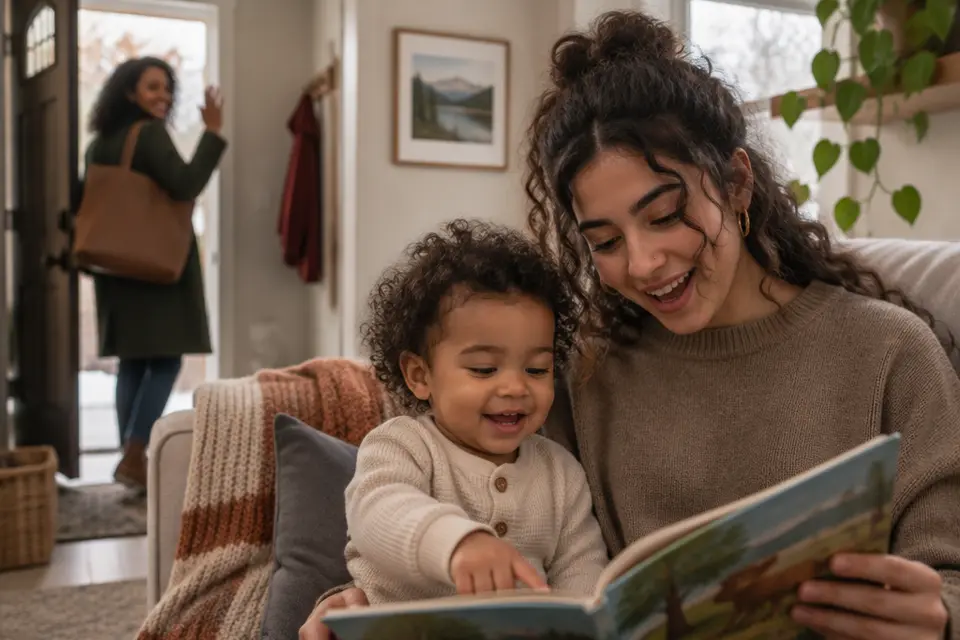
What does a 12 month old do?
Twelve months is a checkpoint on the CDC “Learn the Signs. Act Early” checklist. Your child understands far more than they can say, plays games with you, and starts acting on the world with precision. According to the INSPQ, first words usually appear around this age.
Movement at 12 months
They pull up to stand and walk holding on to furniture. They drink from a cup without a lid that you hold, and pick up small bits of food between thumb and index finger: the pincer grasp.
- Pulls up to stand.
- Walks holding on to furniture.
- Drinks from a cup without a lid, as you hold it.
- Picks things up between thumb and pointer finger.
Language and communication
They wave bye-bye, call a parent “mama”, “dada” or another special name, and understand “no”: pausing briefly or stopping when you say it.
- Waves bye-bye.
- Calls a parent “mama”, “dada” or a special name.
- Understands “no” (pauses or stops).
Feelings and learning
They play games with you like pat-a-cake. They put something in a container, like a block in a cup, and look for things they saw you hide, like a toy under a blanket.
- Plays games with you, like pat-a-cake.
- Puts something in a container.
- Looks for things they saw you hide.
How to play with a 1 year old
They love copying you, doing it again and seeing what happens.
- Roll a ball that they start to send back.
- Show how to stack two blocks and knock them down.
- Name what they point to: “Yes, that’s a dog!”
- Sing action songs.
- Offer large, safe crayons for scribbling, supervised.
When should you talk to a professional?
In Québec, the one-year vaccination visit is a good time to discuss development. A first dental visit is also recommended from age one, according to the INSPQ.
Every child develops at their own pace, and these milestones describe what about three in four children do by this age. If your child is not doing one or more of them yet, loses a skill they had, or something worries you, don’t wait: talk to their doctor or nurse. In Québec, your CLSC access desk can also register your child for an Agir tôt screening without a referral, and Info-Santé 811 answers questions. For a baby born preterm, use the corrected age.
What is worth noting in Maliah
First word, first steps: note them the same day with the date and who saw them. The summary for the doctor will bring them up at the next appointment.
In Maliah, feeds, sleep and diapers are logged in two taps or by voice, and the whole family sees the same entries, each with its author and time. Before an appointment, the summary for the doctor gathers what was noted since the last visit.
Frequently asked questions
What should a 1 year old be doing?
According to the CDC, most twelve-month-olds pull up to stand, walk holding furniture, pick up small things with thumb and index finger, wave bye-bye, say “mama” or “dada” and understand “no”.
My 1 year old isn’t walking alone. Is that normal?
Yes. At one year, walking while holding furniture is the expected milestone. Taking a few steps alone is a fifteen-month milestone on the CDC checklist.
How many words should a 12 month old say?
At twelve months, the CDC milestone is calling a parent “mama”, “dada” or a special name. One or two other words come around fifteen months, three or more around eighteen months.
When is the first dentist visit?
The INSPQ recommends a first visit from age one. In Québec, the RAMQ covers the exam and some dental treatments for children under 10.
Read next
Related free tools
Other guides
Sources : CDC, Learn the Signs. Act Early : listes de repères (révision 2022) · CDC : 2 months · CDC : 4 months · CDC : 6 months · CDC : 9 months · CDC : 1 year · CDC : 15 months · CDC : 18 months · CDC : 2 years · CDC : 3 years · CDC : 4 years · CDC : 5 years · INSPQ, Mieux vivre : Étapes du développement de l’enfant · INSPQ, Mieux vivre : Activités pour soutenir le développement de l’enfant · INSPQ, Mieux vivre : Vous avez des questions sur le développement de votre enfant ? · INSPQ, Mieux vivre : Apprentissage de la propreté · INSPQ, Mieux vivre : Dents de bébé · INSPQ, Mieux vivre : Prévention de la tête plate · Société canadienne de pédiatrie, Soins de nos enfants : Toilet learning · Santé Canada : produits de consommation interdits au Canada (dont les marchettes pour bébés) · Québec.ca : Dépistage de la surdité chez les nouveau-nés
Worried about your child’s health or your pregnancy? In Québec, Info-Santé 811 answers day and night; elsewhere, call your local health line. In an emergency, call 911. This article is for information; it does not replace advice from a health professional. In Québec, call Info-Santé 811 when in doubt (elsewhere in Canada, your provincial health line). In an emergency, call 911. Updated on November 7, 2026.