Key milestones
When do babies start talking?
First words usually appear around one year, and little two-word phrases around two. Here is how language develops from birth to three years, and simple ways to encourage your child to talk.
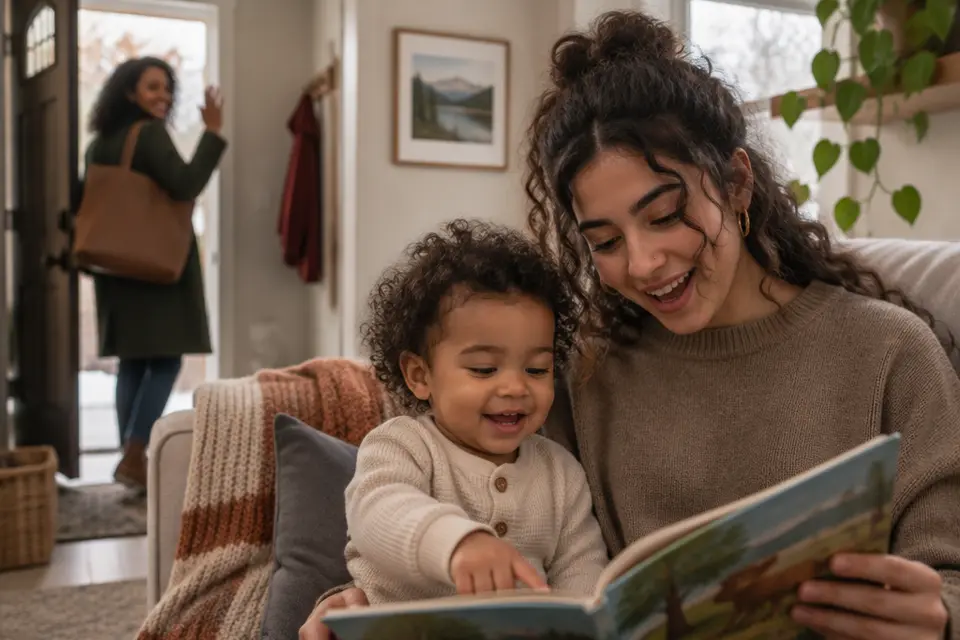
When do babies say their first words?
According to the INSPQ, first words usually appear around twelve months. They often name family members or familiar objects, and it is normal for them to be mispronounced. The CDC “Learn the Signs. Act Early” checklist describes what follows: one or two words besides “mama” or “dada” at fifteen months, three or more words at eighteen months, and two words together at two years.
How language develops
Long before talking, your child communicates: crying, sounds, gestures. They also understand far more words than they say.
- Birth to 2 months: knows your voice, cries to communicate.
- Around 4 months: coos and turns toward your voice.
- Around 6 months: takes turns making sounds, squeals, blows raspberries.
- Around 9 months: babbles “mamama”, “bababa”, lifts arms to be picked up.
- Around 12 months: says “mama” or “dada”, waves bye-bye, understands “no”.
- Around 18 months: three or more words, follows directions without gestures.
- Around 2 years: two words together; around 3 years: holds a conversation.
How to encourage your baby to talk
Everyday exchanges work better than any toy or video.
- Talk about what you are doing and what they are looking at.
- Answer their sounds and gestures as in a real conversation.
- Read together every day and name the pictures.
- Sing nursery rhymes and pause before a familiar word for them to fill in.
- Repeat their words and add one: “Ball!” “Yes, the red ball.”
Hearing, the foundation of language
In Québec, hearing screening is offered to newborns. According to the INSPQ, if your baby does not turn toward sounds between six and nine months, or reacts little or not at all to noise, talk to their health professional as soon as possible. A speech-language pathologist or audiologist can then assess the situation.
When should you talk to a professional?
According to the CDC checklist, it is worth raising if your child doesn’t say at least three words besides “mama” or “dada” at eighteen months, or doesn’t put two words together at two.
Every child develops at their own pace, and a gap of a few weeks is common. If something worries you, if your child loses a skill they had, or is not yet doing what most children their age do, don’t wait: talk to their doctor or nurse. In Québec, your CLSC access desk can register your child for an Agir tôt screening without a referral, and Info-Santé 811 answers questions.
What is worth noting in Maliah
New words arrive quickly and are forgotten just as fast. Noting them in Maliah as they come, with the date, gives you a real list to show the nurse or doctor.
In Maliah, feeds, sleep and diapers are logged in two taps or by voice, and the whole family sees the same entries, each with its author and time. Before an appointment, the summary for the doctor gathers what was noted since the last visit.
Frequently asked questions
When do babies say their first word?
According to the INSPQ, first words usually appear around twelve months. According to the CDC, by one year most children call a parent “mama”, “dada” or a special name.
How many words should an 18 month old say?
According to the CDC, most eighteen-month-olds try to say three or more words besides “mama” or “dada”.
When do babies start putting words together?
Two-word phrases like “More milk” appear around two years, according to the CDC and the INSPQ.
Do screens help babies learn to talk?
No. The INSPQ recommends avoiding videos for little ones and favouring conversation, reading and songs.
Read next
- 12 month old milestones (1 year)
- 18 month old milestones
- 2 year old milestones
- When do babies start laughing?
Related free tools
Other guides
Sources : CDC, Learn the Signs. Act Early : listes de repères (révision 2022) · CDC : 2 months · CDC : 4 months · CDC : 6 months · CDC : 9 months · CDC : 1 year · CDC : 15 months · CDC : 18 months · CDC : 2 years · CDC : 3 years · CDC : 4 years · CDC : 5 years · INSPQ, Mieux vivre : Étapes du développement de l’enfant · INSPQ, Mieux vivre : Activités pour soutenir le développement de l’enfant · INSPQ, Mieux vivre : Vous avez des questions sur le développement de votre enfant ? · INSPQ, Mieux vivre : Apprentissage de la propreté · INSPQ, Mieux vivre : Dents de bébé · INSPQ, Mieux vivre : Prévention de la tête plate · Société canadienne de pédiatrie, Soins de nos enfants : Toilet learning · Santé Canada : produits de consommation interdits au Canada (dont les marchettes pour bébés) · Québec.ca : Dépistage de la surdité chez les nouveau-nés
Worried about your child’s health or your pregnancy? In Québec, Info-Santé 811 answers day and night; elsewhere, call your local health line. In an emergency, call 911. This article is for information; it does not replace advice from a health professional. In Québec, call Info-Santé 811 when in doubt (elsewhere in Canada, your provincial health line). In an emergency, call 911. Updated on November 7, 2026.