Feeding schedule by age
7 to 8 month old feeding schedule: meals, textures and milk
Between seven and eight months, babies eat more often, discover lumpy textures and gradually start to drink a little less milk. Here are Health Canada and INSPQ markers, with an example day.
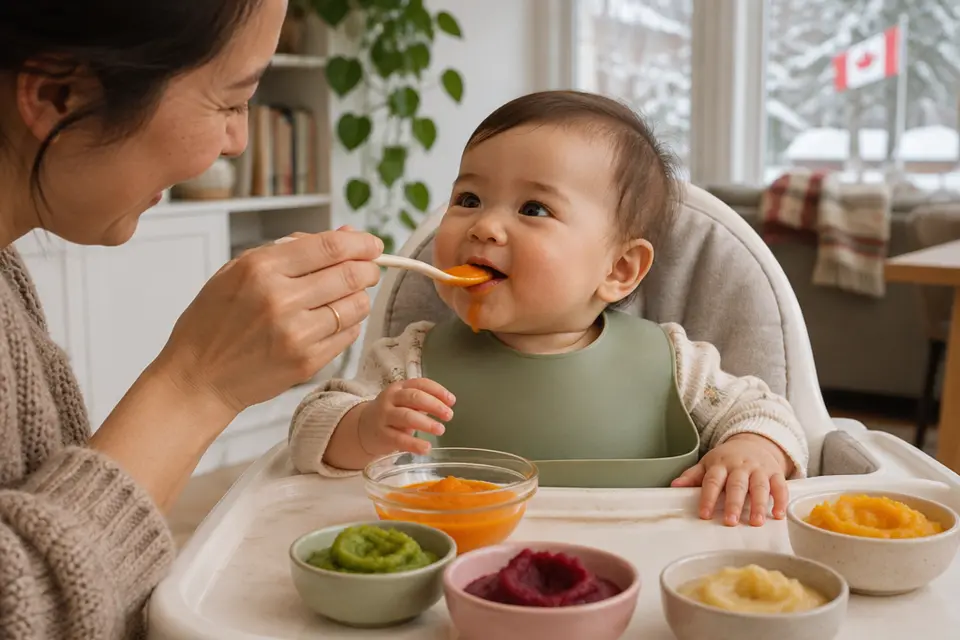
How many meals at 7 and 8 months?
Health Canada suggests offering food two to three times a day between 6 and 8 months, with one or two snacks depending on appetite. Iron-rich foods stay on the menu at least twice a day: meat, fish, egg, tofu, legumes or iron-fortified infant cereal.
Your baby decides how much. Some days they eat a lot, others very little: appetite over several days is what counts.
What textures at 7 and 8 months?
This is the time to move from smooth purées to thicker, lumpy and minced textures. Health Canada recommends offering lumpy textures no later than nine months: waiting longer can make adapting to foods harder.
- Fork-mashed rather than blended foods.
- Finely minced or shredded meat, flaked fish with no bones.
- Soft finger foods: well-cooked vegetables, banana, avocado, cooked pasta.
- Toast strips, grated cheese, plain yogurt.
Finger foods and drinking from a cup
Around this age, babies develop the pincer grasp between thumb and finger and love feeding themselves. Let them explore, even if it’s messy. Water goes in an open cup with meals; Health Canada advises against no-spill valve sippy cups, which don’t build drinking skills.
Your baby always sits strapped into the high chair, supervised by an adult.
What about milk at 7 and 8 months?
According to the INSPQ, the number of milk feeds often stays the same at first, then babies gradually drink less around eight or nine months. Milk remains the main source of nutrients until about one year. It can be offered before or after meals, whichever suits your baby. Cow’s milk waits until 9 to 12 months.
Example day (adapt to your baby)
This example shows one possible rhythm; amounts and times depend on your baby.
- Wake-up: milk feed.
- Breakfast: iron-fortified cereal with mashed fruit.
- Lunch: mashed lentils and vegetables, a few soft pieces; water in a cup.
- Snack: plain yogurt or soft fruit, and a milk feed.
- Supper: flaked fish, sweet potato, cooked pasta; milk feed before bed.
What is worth noting in Maliah
Textures tried and meals eaten or refused are easy to look back on when logged day by day. In Maliah, a feed, a meal or a diaper is logged in two taps or by voice, with the time and the name of whoever logged it. The whole family sees the same log, and a summary of the last few days is ready for the visit with the doctor or nurse.
Frequently asked questions
My 8 month old gags on pieces: should I go back to purées?
Gagging is common while babies learn textures: it is a reflex that protects them. Keep offering suitable pieces and read our page on gagging versus choking.
How many meals for an 8 month old?
Health Canada suggests two to three meals with one or two snacks depending on appetite between 6 and 8 months, then up to three meals around 9 months.
My 7 month old drinks less milk: is that normal?
It is normal for babies to gradually drink less as they eat more, especially around eight or nine months.
Read next
- 6 month old feeding schedule: how to start solid foods
- 9 to 11 month old feeding schedule: meals, snacks and milk
- Baby-led weaning: how to start safely, step by step
- Gagging vs choking in babies: how to tell the difference
Related free tools
Other guides
Sources : INSPQ : Mieux vivre avec notre enfant de la grossesse à deux ans (guide 2026) · INSPQ, Mieux vivre : Quand introduire les aliments ? · INSPQ, Mieux vivre : Comment introduire les aliments ? · INSPQ, Mieux vivre : Diversification alimentaire menée par l’enfant (DME) · INSPQ, Mieux vivre : Risques d’étouffement, à surveiller jusqu’à 4 ans · INSPQ, Mieux vivre : Allergies alimentaires chez l’enfant · INSPQ, Mieux vivre : Bases d’une tétée · INSPQ, Mieux vivre : Manipulation du lait exprimé · INSPQ, Mieux vivre : Tiédir le lait · INSPQ, Mieux vivre : Sevrage de l’allaitement · INSPQ, Mieux vivre : Rots, régurgitations, hoquet et gaz · Santé Canada : Nutrition du nourrisson né à terme et en santé, de 6 à 24 mois · Santé Canada : Nutrition du nourrisson né à terme et en santé, de la naissance à 6 mois · Santé Canada : Allergies alimentaires (allergènes prioritaires) · Santé Canada : Le mercure dans le poisson · Société canadienne de pédiatrie (Soins de nos enfants) : Nourrir votre bébé pendant la première année · Guide alimentaire canadien · Organisation mondiale de la santé : Allaitement
Worried about your child’s health or your pregnancy? In Québec, Info-Santé 811 answers day and night; elsewhere, call your local health line. In an emergency, call 911. This article is for information; it does not replace advice from a health professional. In Québec, call Info-Santé 811 when in doubt (elsewhere in Canada, your provincial health line). In an emergency, call 911. Updated on November 7, 2026.