Breastfeeding and bottles
Gagging vs choking in babies: how to tell the difference
When babies discover solid pieces, gagging is common and normal. Choking is an emergency. Here is how to tell them apart, which foods need careful preparation until age four and what to do, according to Québec’s INSPQ.
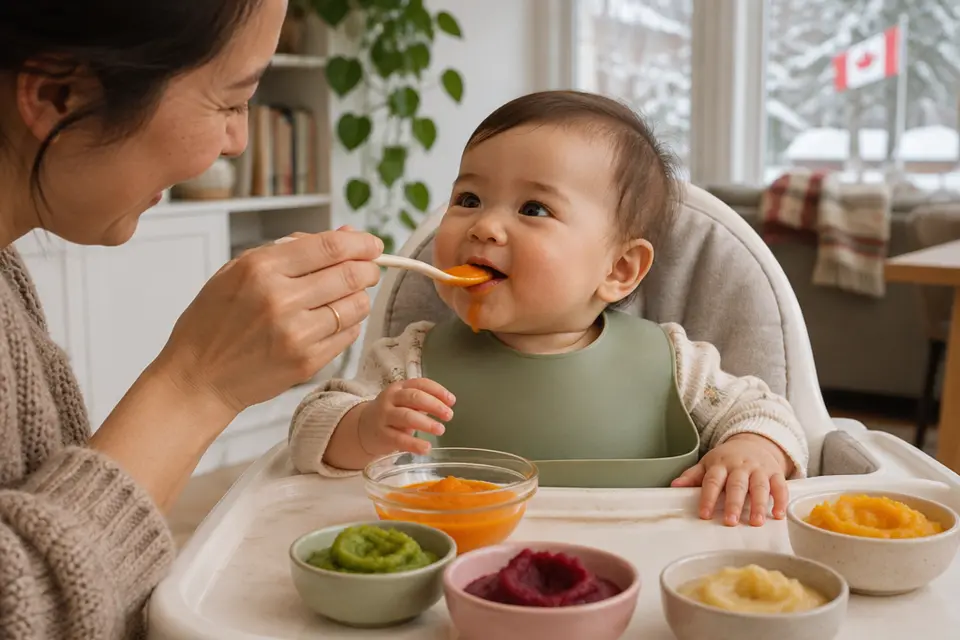
What is gagging?
Gagging is a reflex that protects babies: when a piece goes too far back in the mouth, the tongue pushes it forward. Your baby’s eyes may water, they may stick out the tongue, cough or bring a little food back up. It’s noisy and alarming, but they are breathing. The INSPQ notes that self-feeding babies often gag more, without choking more. The reflex fades as babies learn to chew.
How do I recognize choking?
Choking happens when food blocks the airway, partly or completely.
- Gagging: the baby coughs, makes noise, turns red, then goes back to eating.
- Partial choking: strong coughing or wheezy breathing; air is still moving.
- Complete choking: the baby can’t cough, cry, breathe or make a sound; they may turn pale or bluish.
- In that last case, call 911 immediately.
What to do during gagging or coughing
Stay calm, close to your baby, and let them cough: coughing is the best way to clear what’s in the way. Don’t sweep your fingers blindly in their mouth, which can push food further in. If coughing becomes ineffective or your baby stops breathing, call 911. The INSPQ recommends taking a first-aid course to learn the right techniques for babies and children, offered by the Red Cross and St. John Ambulance, among others.
Which foods are risky until age 4?
According to the INSPQ, hard, small, round, smooth or sticky foods are the riskiest:
- peanuts and other nuts, seeds;
- hard candy, lozenges, gum, popcorn, marshmallows;
- whole fresh grapes and raisins, sausage rounds;
- raw carrot and celery, food on toothpicks or skewers, ice cubes;
- to do: cut grapes into quarters, grate hard raw fruit and vegetables, remove pits, bones and fish bones, spread nut butters thinly.
Mealtime safety rules
Children always eat seated, strapped into the high chair, supervised by an adult. No eating while walking, running, playing or in the car. Keep risky foods out of reach and ask older children to follow the same rules. After a choking episode, even if resolved, have your child seen by a doctor, or call a health line (811 in Québec) to find out where to go.
What is worth noting in Maliah
When several adults handle meals, a shared note is a reminder of which foods to cut or avoid. In Maliah, a feed, a meal or a diaper is logged in two taps or by voice, with the time and the name of whoever logged it. The whole family sees the same log, and a summary of the last few days is ready for the visit with the doctor or nurse.
Frequently asked questions
My baby gags at every meal: is that normal?
Yes, it’s common while discovering new textures. If it lasts a long time or your baby vomits often, talk to your doctor or nurse.
Should I pat the back of a coughing baby?
No, if they’re coughing, let them cough. If they can’t cough, cry or breathe, call 911; a first-aid course teaches the right techniques.
At what age does the choking risk go down?
The INSPQ recommends staying careful with high-risk foods until age four.
Read next
- Baby-led weaning: how to start safely, step by step
- When can babies eat grapes, and how should you cut them?
- When can babies eat nuts? Allergy and choking safety
- 7 to 8 month old feeding schedule: meals, textures and milk
Related free tools
Other guides
Sources : INSPQ : Mieux vivre avec notre enfant de la grossesse à deux ans (guide 2026) · INSPQ, Mieux vivre : Quand introduire les aliments ? · INSPQ, Mieux vivre : Comment introduire les aliments ? · INSPQ, Mieux vivre : Diversification alimentaire menée par l’enfant (DME) · INSPQ, Mieux vivre : Risques d’étouffement, à surveiller jusqu’à 4 ans · INSPQ, Mieux vivre : Allergies alimentaires chez l’enfant · INSPQ, Mieux vivre : Bases d’une tétée · INSPQ, Mieux vivre : Manipulation du lait exprimé · INSPQ, Mieux vivre : Tiédir le lait · INSPQ, Mieux vivre : Sevrage de l’allaitement · INSPQ, Mieux vivre : Rots, régurgitations, hoquet et gaz · Santé Canada : Nutrition du nourrisson né à terme et en santé, de 6 à 24 mois · Santé Canada : Nutrition du nourrisson né à terme et en santé, de la naissance à 6 mois · Santé Canada : Allergies alimentaires (allergènes prioritaires) · Santé Canada : Le mercure dans le poisson · Société canadienne de pédiatrie (Soins de nos enfants) : Nourrir votre bébé pendant la première année · Guide alimentaire canadien · Organisation mondiale de la santé : Allaitement
Worried about your child’s health or your pregnancy? In Québec, Info-Santé 811 answers day and night; elsewhere, call your local health line. In an emergency, call 911. This article is for information; it does not replace advice from a health professional. In Québec, call Info-Santé 811 when in doubt (elsewhere in Canada, your provincial health line). In an emergency, call 911. Updated on November 7, 2026.