By age
15 month old sleep schedule
At fifteen months, most toddlers still take two naps, but some start resisting the morning one. Canadian benchmarks, an example day and how to tell whether the switch to one nap is coming.
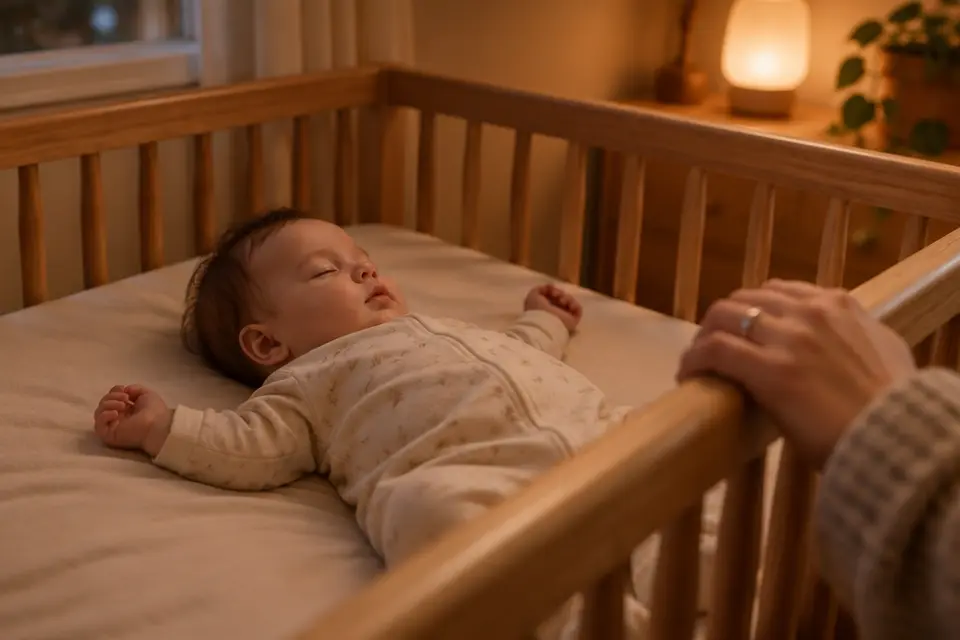
How many hours does a 15 month old sleep?
For children aged 1 to 2, the Canadian 24-Hour Movement Guidelines and the Canadian Paediatric Society give 11 to 14 hours of sleep a day, naps included. According to the INSPQ, children this age sleep 8 to 12 hours at night.
These ranges are wide: two children of the same age can have different needs and both be thriving.
One or two naps at 15 months?
According to the INSPQ, children usually need two naps until about 18 months, and may need only one between 18 months and 2 years. At fifteen months, two naps are still the most common.
Some children show signs earlier: a morning nap that does not happen, or that pushes the afternoon nap so late that bedtime gets hard. Many families then alternate one-nap and two-nap days for a while.
Example day at 15 months, to adapt
An example only, to adapt: every baby has their own rhythm, and times shift from day to day. Two-nap version; on one-nap days, the nap goes after lunch.
- Around 7:00 a.m.: wake, breakfast.
- Around 10:00 a.m.: short morning nap.
- Around 11:30 a.m.: lunch.
- Around 2:00 p.m.: afternoon nap, over around 3:30 p.m.
- Around 5:00 p.m.: supper.
- Around 7:00 to 7:30 p.m.: routine and bed.
Tiredness cues in a 15 month old
Yawning, rubbing the eyes, red or puffy eyes: these are the tiredness cues public health services describe. According to the Canadian Paediatric Society, an overtired baby settles less easily, which is why putting them down when these cues show up often works better than watching the clock. At fifteen months, a tired toddler may also stumble more while walking, refuse a meal or ask to be carried more often.
What changes since 12 months
According to the CDC, many children take a few steps on their own around fifteen months and say one or two words besides “mama” and “dada.” These skills keep their days busy, and sometimes their nights.
The INSPQ notes that separation anxiety at bedtime can last until 18 months or longer: a consistent routine, applied with gentle firmness, helps reassure your child.
Safe sleep reminder after one year
The crib remains a good place as long as it meets Canadian standards and your child cannot climb out alone. The Canadian Paediatric Society advises against putting a child to bed with a bottle, because of the risk of choking and tooth decay.
It also advises avoiding screens before bed. If your child snores loudly, seems to gasp or stops breathing for moments during sleep, talk to their doctor; in Québec, Info-Santé 811 answers day and night, and 911 is for emergencies.
What is worth logging in Maliah
In Maliah, a sleep is logged with a tap or by voice, with the time and the name of whoever logged it. Your partner, the grandparents or the babysitter see the last sleep and the last feed without texting, and the summary over a few weeks can be shown to the doctor or nurse. At fifteen months, seeing over two weeks how many days the morning nap was skipped helps you decide whether it is time for one nap.
Frequently asked questions
Is my 15 month old ready for one nap?
Maybe, but it is early: the INSPQ places that switch between 18 months and 2 years. If the morning nap is skipped several days in a row and your child stays in a good mood, talk with your daycare to line things up.
How much does a 15 month old sleep?
11 to 14 hours a day, naps included, according to the Canadian guidelines and the Canadian Paediatric Society.
My 15 month old cries at bedtime. What can I do?
Separation anxiety at bedtime can last until 18 months or longer, according to the INSPQ. A short routine, always the same, and a calm goodbye help.
Read next
- 12 month old sleep schedule
- 18 month old sleep schedule
- Dropping naps: when babies go from three naps to two, then one
Related free tools
Other guides
Sources : INSPQ, Mieux vivre : Dormir en sécurité · INSPQ, Mieux vivre : Mort subite du nourrisson · INSPQ, Mieux vivre : Prévention de la tête plate · INSPQ, Mieux vivre : Sommeil dans les premières semaines de vie · INSPQ, Mieux vivre : Sommeil autour de l’âge de 4 mois · INSPQ, Mieux vivre : Sommeil après 6 mois · INSPQ, Mieux vivre : Sommeil entre 1 et 2 ans · Société canadienne de pédiatrie, Caring for Kids : Healthy sleep for your baby and child · Directives canadiennes en matière de mouvement sur 24 heures pour la petite enfance (0 à 4 ans) · Agence de la santé publique du Canada : Sommeil sécuritaire · Santé Canada : Votre enfant est-il en sécurité ? L’heure du coucher · American Academy of Pediatrics, HealthyChildren.org : Getting your baby to sleep · Pediatrics (AAP), 2014 : Infant sleep machines and hazardous sound pressure levels · CDC, Learn the Signs. Act Early : étapes du développement · 811 Nouvelle-Écosse : Pleurs de bébé avant l’âge d’un an · Québec.ca : Info-Santé 811
Worried about your child’s health or your pregnancy? In Québec, Info-Santé 811 answers day and night; elsewhere, call your local health line. In an emergency, call 911. This article is for information; it does not replace advice from a health professional. In Québec, call Info-Santé 811 when in doubt (elsewhere in Canada, your provincial health line). In an emergency, call 911. Updated on November 7, 2026.