Sleep topics
Dropping naps: when babies go from three naps to two, then one
Three naps around 4 months, two between 6 and 12 months, one between 18 months and 2 years, and sometimes none around age 3. The ages Canadian sources give, signs your child is ready and how to make the switch.
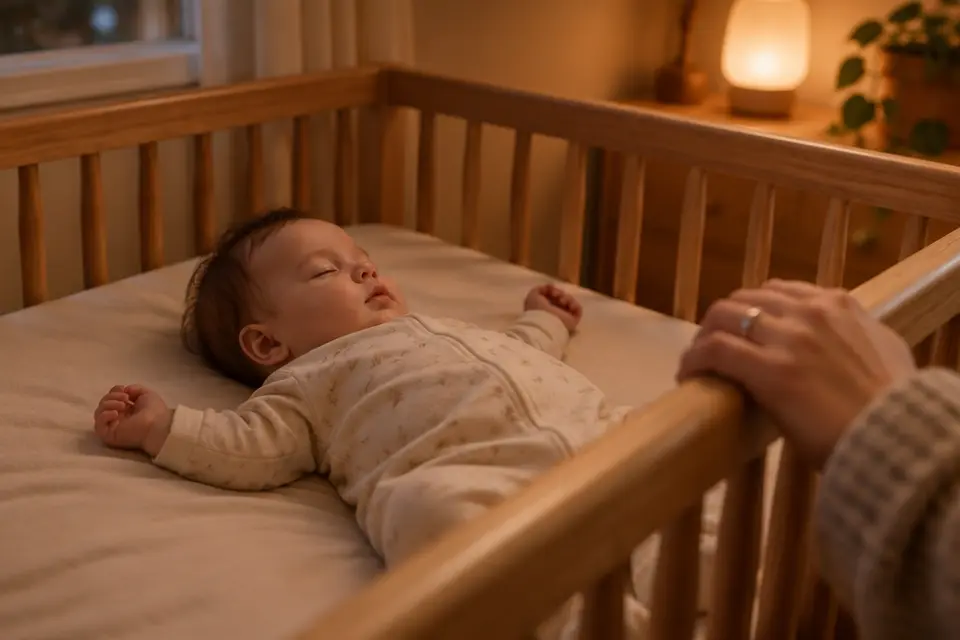
The main nap milestones
What Canadian sources describe:
- around 4 months: most babies take three naps (Canadian Paediatric Society);
- between 6 and 12 months: often a move to two longer naps (CPS);
- until about 18 months: two naps, one in the morning and one in the afternoon (INSPQ);
- between 18 months and 2 years: one nap may be enough (INSPQ);
- around age 3: often one nap, and some children stop; quiet time can replace it (CPS).
From three naps to two
The third nap, late in the afternoon, is often the shortest. When it becomes hard to get or pushes bedtime back a lot, your baby is often ready to drop it. For a few weeks, some days have three naps and some have two.
On two-nap days, a slightly earlier bedtime keeps the end of the day from getting too long.
From two naps to one
Signs often seen: the morning nap not happening several days in a row, or, when it does happen, getting in the way of the afternoon nap. The INSPQ places this switch between 18 months and 2 years; a few days of refusal around one year are often a passing phase.
The single nap usually goes after lunch, as in most daycares. During the transition, your child may be tired late in the day: moving bedtime earlier helps. The CPS advises avoiding late-day naps for toddlers.
When naps end
According to the Canadian Paediatric Society, many preschoolers move to one nap around age 3, and some stop completely. Quiet time in bed or with books keeps a rest break in the day.
If your child still naps but falls asleep very late at night, shortening the nap or ending it earlier is often an in-between step.
Signs the switch is happening too fast
A child who is very irritable late in the day, falls asleep during meals or in the car, or wakes more at night may still need the nap that was dropped. Going back for a few weeks is not a failure.
If your child seems exhausted despite full nights, snores loudly or pauses breathing while asleep, talk to their doctor (CPS); in Québec, Info-Santé 811 answers day and night.
What is worth logging in Maliah
In Maliah, a sleep is logged with a tap or by voice, with the time and the name of whoever logged it. Your partner, the grandparents or the babysitter see the last sleep and the last feed without texting, and the summary over a few weeks can be shown to the doctor or nurse. The number of naps per day, logged over two or three weeks, shows whether a transition is really settling in or was just a few bad days.
Frequently asked questions
When do babies go to two naps?
Often between 6 and 12 months, according to the Canadian Paediatric Society.
When do toddlers go to one nap?
Between 18 months and 2 years, according to the INSPQ. Before 18 months, most children still need two naps.
When do children stop napping?
The CPS says some children stop around age 3; others keep a nap longer. Quiet time can replace it.
Should bedtime be earlier during a nap transition?
It is a common fix: a slightly earlier bedtime makes up for the missing nap while your child adjusts.
Read next
Related free tools
Other guides
Sources : INSPQ, Mieux vivre : Dormir en sécurité · INSPQ, Mieux vivre : Mort subite du nourrisson · INSPQ, Mieux vivre : Prévention de la tête plate · INSPQ, Mieux vivre : Sommeil dans les premières semaines de vie · INSPQ, Mieux vivre : Sommeil autour de l’âge de 4 mois · INSPQ, Mieux vivre : Sommeil après 6 mois · INSPQ, Mieux vivre : Sommeil entre 1 et 2 ans · Société canadienne de pédiatrie, Caring for Kids : Healthy sleep for your baby and child · Directives canadiennes en matière de mouvement sur 24 heures pour la petite enfance (0 à 4 ans) · Agence de la santé publique du Canada : Sommeil sécuritaire · Santé Canada : Votre enfant est-il en sécurité ? L’heure du coucher · American Academy of Pediatrics, HealthyChildren.org : Getting your baby to sleep · Pediatrics (AAP), 2014 : Infant sleep machines and hazardous sound pressure levels · CDC, Learn the Signs. Act Early : étapes du développement · 811 Nouvelle-Écosse : Pleurs de bébé avant l’âge d’un an · Québec.ca : Info-Santé 811
Worried about your child’s health or your pregnancy? In Québec, Info-Santé 811 answers day and night; elsewhere, call your local health line. In an emergency, call 911. This article is for information; it does not replace advice from a health professional. In Québec, call Info-Santé 811 when in doubt (elsewhere in Canada, your provincial health line). In an emergency, call 911. Updated on November 7, 2026.