By age
6 month old sleep schedule
At six months, many babies sleep 8 to 10 hours at night and gradually go from three naps to two. Benchmarks from the INSPQ and Canadian Paediatric Society, an example day and tiredness cues.
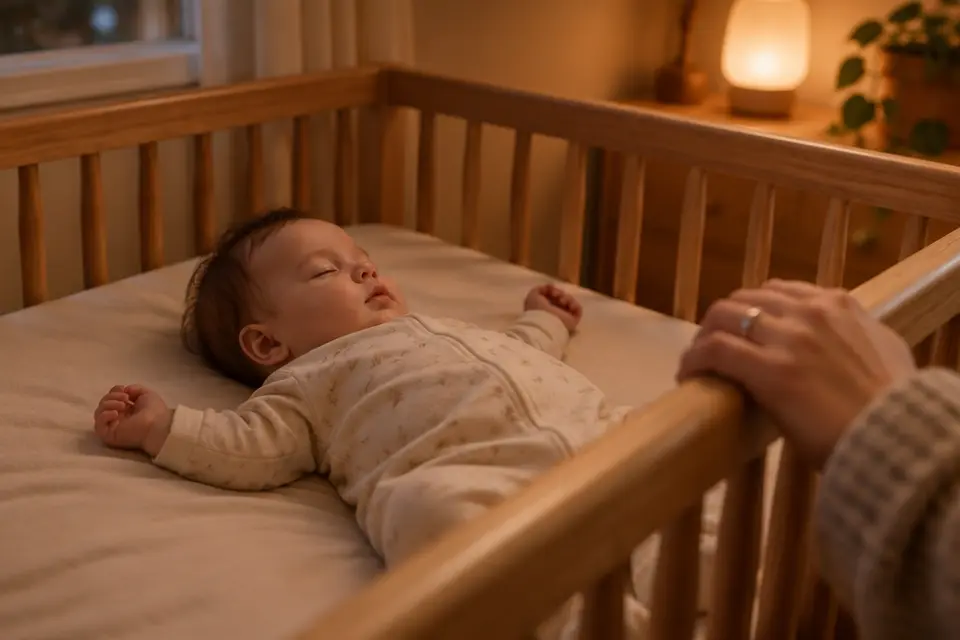
How many hours does a 6 month old sleep?
According to the INSPQ, most babies aged 6 to 12 months sleep 8 to 10 hours at night. Over 24 hours, the Canadian guidelines give a range of 12 to 16 hours, naps included.
Also according to the INSPQ, about 85% of babies sleep 5 hours or more in a row around six months. Waking briefly and falling back asleep is part of normal sleep at this age, the American Academy of Pediatrics adds.
How many naps at 6 months?
The Canadian Paediatric Society says that between 6 and 12 months, babies often move to two longer naps. At six months, many still take a short third nap late in the day, while others have already dropped it.
The switch is rarely sudden: some days with three naps, some with two, and an earlier bedtime on shorter days.
Example day at 6 months, to adapt
An example only, to adapt: every baby has their own rhythm, and times shift from day to day.
- Around 7:00 a.m.: wake, feed, then a meal if solids have started.
- Around 9:30 a.m.: morning nap.
- Around 1:30 p.m.: afternoon nap.
- Late afternoon: a short nap for some babies only.
- Around 7:00 to 7:30 p.m.: routine and bed.
- Night: about 8 to 10 hours, sometimes with one or more wakings.
Tiredness cues in a 6 month old
Yawning, rubbing the eyes, red or puffy eyes: these are the tiredness cues public health services describe. According to the Canadian Paediatric Society, an overtired baby settles less easily, which is why putting them down when these cues show up often works better than watching the clock. At six months, tiredness can also show as a baby who clings more to a parent or cries as soon as you step away.
What changes since 5 months
Around six months, the CPS suggests that when your baby wakes at night, you check for discomfort (too hot, too cold) while trying not to take them out of the crib, and soothe them with a gentle touch or soft voice.
It is also the end of the six-month period during which the CPS and Health Canada recommend room sharing. Whether your baby stays in your room or moves to their own, the safe-crib rules stay the same.
Reminder: safe sleep
According to the INSPQ and the Public Health Agency of Canada, babies sleep on their back, on a firm, flat mattress, in a crib, cradle or bassinet that meets Canadian standards, with only a fitted sheet: no pillow, duvet, bumper pad or stuffed toy. Once the baby rolls over alone, the INSPQ says you can leave them in the position they choose.
The Canadian Paediatric Society and Health Canada recommend that babies sleep in their parents’ room, but in their own bed, for the first six months. A car seat is for travel, not for sleep. A smoke-free home, breastfeeding and up-to-date vaccines are among the things that lower the risk of sudden infant death, according to the INSPQ.
What is worth logging in Maliah
In Maliah, a sleep is logged with a tap or by voice, with the time and the name of whoever logged it. Your partner, the grandparents or the babysitter see the last sleep and the last feed without texting, and the summary over a few weeks can be shown to the doctor or nurse. At six months, starting solids and shifting naps make a shared log useful, one the babysitter or daycare can follow too.
Frequently asked questions
How many hours does a 6 month old sleep at night?
According to the INSPQ, most babies aged 6 to 12 months sleep 8 to 10 hours at night, sometimes with wakings.
How many naps does a 6 month old take?
Often two or three. The Canadian Paediatric Society says babies often move to two longer naps between 6 and 12 months.
Can my 6 month old sleep in their own room?
The CPS and Health Canada recommend room sharing for the first six months. After that, it is a family choice; the crib must still meet standards and have no soft objects.
Read next
- 5 month old sleep schedule
- 7 month old sleep schedule
- Dropping naps: when babies go from three naps to two, then one
Related free tools
Other guides
Sources : INSPQ, Mieux vivre : Dormir en sécurité · INSPQ, Mieux vivre : Mort subite du nourrisson · INSPQ, Mieux vivre : Prévention de la tête plate · INSPQ, Mieux vivre : Sommeil dans les premières semaines de vie · INSPQ, Mieux vivre : Sommeil autour de l’âge de 4 mois · INSPQ, Mieux vivre : Sommeil après 6 mois · INSPQ, Mieux vivre : Sommeil entre 1 et 2 ans · Société canadienne de pédiatrie, Caring for Kids : Healthy sleep for your baby and child · Directives canadiennes en matière de mouvement sur 24 heures pour la petite enfance (0 à 4 ans) · Agence de la santé publique du Canada : Sommeil sécuritaire · Santé Canada : Votre enfant est-il en sécurité ? L’heure du coucher · American Academy of Pediatrics, HealthyChildren.org : Getting your baby to sleep · Pediatrics (AAP), 2014 : Infant sleep machines and hazardous sound pressure levels · CDC, Learn the Signs. Act Early : étapes du développement · 811 Nouvelle-Écosse : Pleurs de bébé avant l’âge d’un an · Québec.ca : Info-Santé 811
Worried about your child’s health or your pregnancy? In Québec, Info-Santé 811 answers day and night; elsewhere, call your local health line. In an emergency, call 911. This article is for information; it does not replace advice from a health professional. In Québec, call Info-Santé 811 when in doubt (elsewhere in Canada, your provincial health line). In an emergency, call 911. Updated on November 7, 2026.