Sleep regressions
8 month sleep regression: separation anxiety and new skills
Around eight months, many babies start crying at bedtime and waking at night again. The INSPQ sees a normal period of separation anxiety, often mixed with big motor milestones.
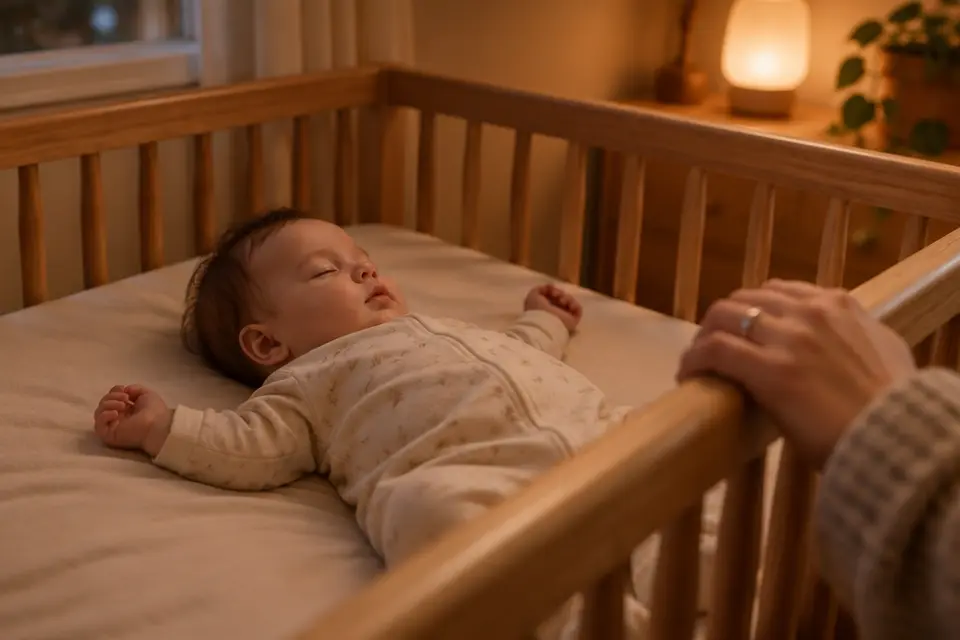
What is the 8 month sleep regression?
“Sleep regression” is not a medical term: it does not appear in INSPQ or Canadian Paediatric Society guidance. It is the name parents give to a stretch when a child who was sleeping fairly well starts waking again, fighting naps or crying at bedtime.
Around eight months, parents mostly describe crying as soon as they leave the room, night wakings that come back and naps that get shorter or refused.
Why do wakings come back around 8 months?
According to the INSPQ, between 6 and 12 months some babies start waking at night again: it is a normal period of separation anxiety. During the day, too, babies react more strongly when a parent leaves, changes rooms or puts them to bed.
It is also an age of big learning: crawling, sitting alone, pulling up to stand. The CDC describes, around nine months, a baby who sits without support and may be shy or clingy with strangers. These skills sometimes get practised… in the crib.
How long does the 8 month sleep regression last?
No official source measures how long a “regression” lasts. Parents most often describe it as a few weeks, fading as the child masters the new stage. If the difficulties last for months, it is no longer just a passing phase, and it is worth talking to a health professional.
What helps during the 8 month regression?
The INSPQ and the Canadian Paediatric Society suggest simple steps:
- when your baby wakes up crying, show up, speak softly, lay a hand on them: often that is enough;
- check for discomfort (too hot, too cold) while trying not to take them out of the crib, the CPS suggests;
- keep the same evening routine every night, even through rough nights;
- give plenty of daytime practice for new skills;
- if you want them to learn to fall asleep alone, spend a little less time in the room each evening, as the INSPQ describes;
- short, calm goodbyes during the day too, so they learn you come back.
When to call 811 or see a health professional
If your baby cries a lot at night, the INSPQ suggests first checking whether they are sick, for example whether they have a fever, before assuming it is just a phase.
Official sources give a few markers for asking advice from your doctor, nurse or local health line (Info-Santé 811 in Québec):
- your baby cries a lot at night: the INSPQ suggests first checking whether they are sick;
- wakings continue despite a routine and worry you, or you cannot set up a routine (INSPQ);
- your child snores loudly, seems to gasp or stops breathing for moments during sleep (Canadian Paediatric Society);
- you are at the end of your rope: health lines also support exhausted parents (Info-Social 811 in Québec);
- in an emergency, such as trouble breathing, call 911.
What is worth logging in Maliah
In Maliah, a sleep is logged with a tap or by voice, with the time and the name of whoever logged it. Your partner, the grandparents or the babysitter see the last sleep and the last feed without texting, and the summary over a few weeks can be shown to the doctor or nurse. During a regression, seeing the time and length of each waking, logged by whichever parent got up, saves retelling the night over breakfast.
Frequently asked questions
Why does my 8 month old cry when I leave the room?
It is separation anxiety, normal between 6 and 12 months according to the INSPQ. A consistent routine, a soft voice and your reassuring presence help them through it.
How long does the 8 month sleep regression last?
No official source measures it; it is often described as a few weeks. If wakings have lasted for months, talk to your doctor.
My 8 month old stands in the crib and won’t sleep. What can I do?
Calmly laying them back down and giving daytime practice often helps. Make sure the mattress is at its lowest setting.
Could the 8 month regression be an illness?
No, but a sick baby also sleeps worse. If your baby seems sick or you are worried, call your doctor or health line (811 in Québec).
Read next
- 8 month old sleep schedule
- Baby night wakings: why babies wake and what helps
- 12 month sleep regression: first steps and the morning nap
Related free tools
Other guides
Sources : INSPQ, Mieux vivre : Dormir en sécurité · INSPQ, Mieux vivre : Mort subite du nourrisson · INSPQ, Mieux vivre : Prévention de la tête plate · INSPQ, Mieux vivre : Sommeil dans les premières semaines de vie · INSPQ, Mieux vivre : Sommeil autour de l’âge de 4 mois · INSPQ, Mieux vivre : Sommeil après 6 mois · INSPQ, Mieux vivre : Sommeil entre 1 et 2 ans · Société canadienne de pédiatrie, Caring for Kids : Healthy sleep for your baby and child · Directives canadiennes en matière de mouvement sur 24 heures pour la petite enfance (0 à 4 ans) · Agence de la santé publique du Canada : Sommeil sécuritaire · Santé Canada : Votre enfant est-il en sécurité ? L’heure du coucher · American Academy of Pediatrics, HealthyChildren.org : Getting your baby to sleep · Pediatrics (AAP), 2014 : Infant sleep machines and hazardous sound pressure levels · CDC, Learn the Signs. Act Early : étapes du développement · 811 Nouvelle-Écosse : Pleurs de bébé avant l’âge d’un an · Québec.ca : Info-Santé 811
Worried about your child’s health or your pregnancy? In Québec, Info-Santé 811 answers day and night; elsewhere, call your local health line. In an emergency, call 911. This article is for information; it does not replace advice from a health professional. In Québec, call Info-Santé 811 when in doubt (elsewhere in Canada, your provincial health line). In an emergency, call 911. Updated on November 7, 2026.