Sleep topics
Baby night wakings: why babies wake and what helps
Night wakings are part of normal sleep for babies and toddlers. What the INSPQ and the Canadian Paediatric Society say about the causes, how to respond and the markers for seeking advice.
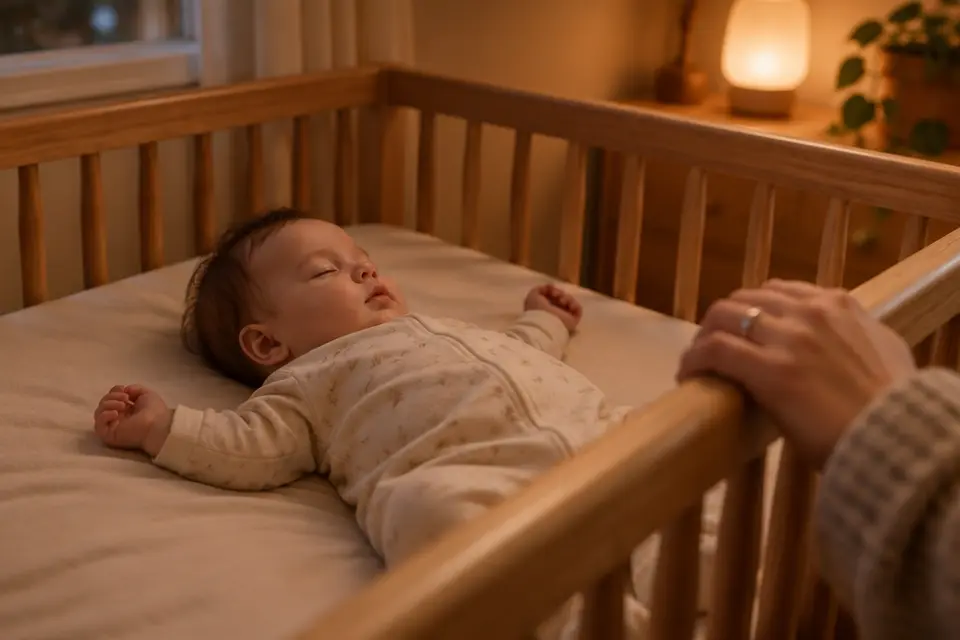
Is it normal for a baby to wake at night?
Yes. Night wakings are normal in young babies, the Canadian Paediatric Society notes, adding that many wake to feed. Even later, brief wakings between sleep cycles are part of normal sleep: the American Academy of Pediatrics says a six month old may wake and fall back asleep alone within a few minutes.
According to the INSPQ, about 90% of babies sleep 5 hours or more in a row around 10 months, which also means wakings remain common throughout the first year.
Why do babies wake at night?
The causes change with age:
- hunger, especially in the early months; between 4 and 6 months some babies still need night feeds, others do not (INSPQ);
- sleep reorganizing around 4 months;
- sleep-onset conditions: a baby who fell asleep at the breast, with a bottle or being rocked often looks for the same help to fall back asleep (INSPQ);
- separation anxiety, normal between 6 and 12 months and sometimes until 18 months or longer (INSPQ);
- discomfort: too hot, too cold, diaper;
- later on, nightmares and night terrors (INSPQ);
- illness: a sick baby sleeps less well.
How to respond to night wakings
The CPS suggests giving your baby a few minutes to resettle before stepping in. Around six months, it suggests checking for discomfort while trying not to take them out of the crib, and soothing them with a gentle touch or soft voice.
For night feeds and diaper changes: low light, calm movements and few words. If your baby wakes up crying, the INSPQ notes that a parent’s presence and a soft voice are often enough to reassure them.
Nightmares or night terrors?
In toddlers, the INSPQ distinguishes a night terror, where the child screams or cries while seeming deeply asleep (no need to wake them or step in unless they could get hurt), from a nightmare, after which they wake panicked and fully alert and can be comforted. Both usually fade with age.
When to call 811 or see a health professional
The INSPQ describes disturbed sleep as wakings more than twice a night, lasting over 20 minutes, needing a parent there, more than four or five nights out of seven, for at least three months.
Official sources give a few markers for asking advice from your doctor, nurse or local health line (Info-Santé 811 in Québec):
- your baby cries a lot at night: the INSPQ suggests first checking whether they are sick;
- wakings continue despite a routine and worry you, or you cannot set up a routine (INSPQ);
- your child snores loudly, seems to gasp or stops breathing for moments during sleep (Canadian Paediatric Society);
- you are at the end of your rope: health lines also support exhausted parents (Info-Social 811 in Québec);
- in an emergency, such as trouble breathing, call 911.
What is worth logging in Maliah
In Maliah, a sleep is logged with a tap or by voice, with the time and the name of whoever logged it. Your partner, the grandparents or the babysitter see the last sleep and the last feed without texting, and the summary over a few weeks can be shown to the doctor or nurse. Each waking logged by the parent who got up, with the time and length, builds in a few weeks a clear picture to show the doctor if you are nearing the INSPQ markers.
Frequently asked questions
How many night wakings are normal for a baby?
There is no official number; wakings are normal, especially in the first year. The INSPQ speaks of disturbed sleep beyond two wakings a night of over 20 minutes, most nights, for at least three months.
Should I go to my baby as soon as they cry at night?
The Canadian Paediatric Society suggests giving them a few minutes to resettle. If the crying continues, your presence and a soft voice reassure them.
Why is my 9 month old waking at night again?
Between 6 and 12 months, separation anxiety often brings back wakings, according to the INSPQ. First check that your baby is not sick; if in doubt, call your doctor or health line (811 in Québec).
Read next
- When do babies sleep through the night, and what does it mean?
- 8 month sleep regression: separation anxiety and new skills
- Sleep training methods: what they are, without judgment
Related free tools
Other guides
Sources : INSPQ, Mieux vivre : Dormir en sécurité · INSPQ, Mieux vivre : Mort subite du nourrisson · INSPQ, Mieux vivre : Prévention de la tête plate · INSPQ, Mieux vivre : Sommeil dans les premières semaines de vie · INSPQ, Mieux vivre : Sommeil autour de l’âge de 4 mois · INSPQ, Mieux vivre : Sommeil après 6 mois · INSPQ, Mieux vivre : Sommeil entre 1 et 2 ans · Société canadienne de pédiatrie, Caring for Kids : Healthy sleep for your baby and child · Directives canadiennes en matière de mouvement sur 24 heures pour la petite enfance (0 à 4 ans) · Agence de la santé publique du Canada : Sommeil sécuritaire · Santé Canada : Votre enfant est-il en sécurité ? L’heure du coucher · American Academy of Pediatrics, HealthyChildren.org : Getting your baby to sleep · Pediatrics (AAP), 2014 : Infant sleep machines and hazardous sound pressure levels · CDC, Learn the Signs. Act Early : étapes du développement · 811 Nouvelle-Écosse : Pleurs de bébé avant l’âge d’un an · Québec.ca : Info-Santé 811
Worried about your child’s health or your pregnancy? In Québec, Info-Santé 811 answers day and night; elsewhere, call your local health line. In an emergency, call 911. This article is for information; it does not replace advice from a health professional. In Québec, call Info-Santé 811 when in doubt (elsewhere in Canada, your provincial health line). In an emergency, call 911. Updated on November 7, 2026.