Sleep topics
Baby wake windows: a useful guide, not a rule
“Wake windows” are all over social media, with charts down to the minute. Here is what the idea means, why there are no official numbers, and what guides you better: your baby’s tiredness cues.
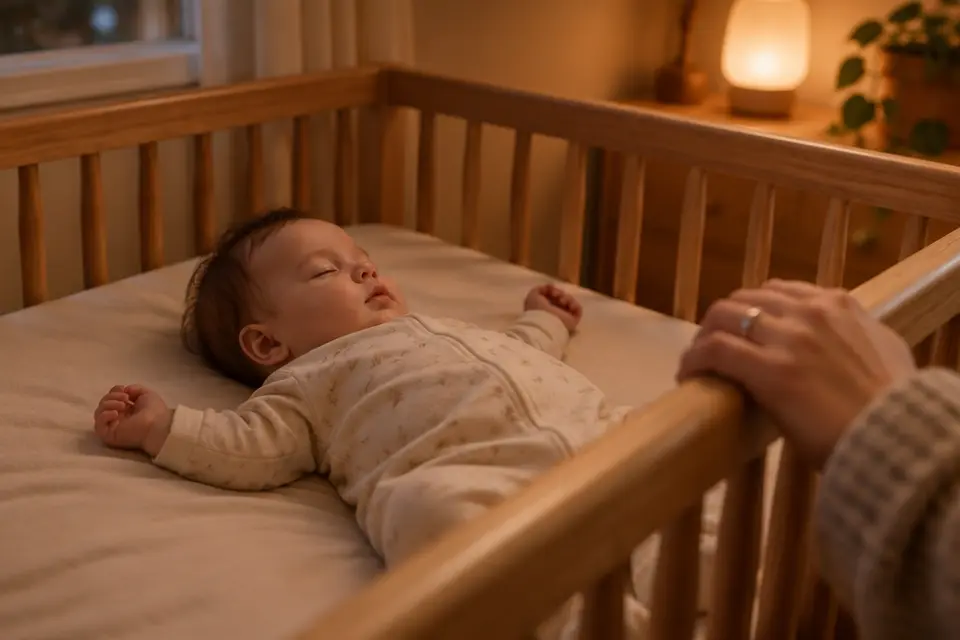
What is a wake window?
A “wake window” is the time a baby spends awake between two sleeps, for example from the end of one nap to the start of the next. The idea: if they stay awake too long, they become overtired and struggle to fall asleep; if they go down too early, they are not sleepy yet.
The principle matches what the Canadian Paediatric Society says: an overtired baby settles less easily, and naps help babies sleep better at night.
Are there official wake window lengths?
No. Neither the INSPQ, the Canadian Paediatric Society, Health Canada nor the American Academy of Pediatrics publishes a wake window chart by age. The INSPQ only says that awake periods lengthen over the weeks and vary with each baby’s needs and temperament: some newborns wake almost only to feed, others stay awake longer from the first days.
The precise lengths you see online mostly come from books, blogs and apps, not from studies that validated them.
Commonly cited ranges, to use with caution
For general information only, and with no official standing, the ranges that circulate usually go from under an hour for a newborn to a few hours for a toddler on one nap, increasing gradually through the first year.
If you use them, treat them as a starting point, never as an instruction: a baby showing tiredness cues before the end of their “window” needs sleep, and a wide-awake baby does not have to go down because the clock says so.
Tiredness cues: the best guide
Public health services describe simple cues:
- yawning;
- rubbing the eyes, red or puffy eyes;
- looking away, losing interest in play;
- crying, irritability, unusual restlessness;
- in older babies, clumsiness or wanting to be held.
How to use these cues day to day
Watching for a few days when your baby shows the first tiredness cues gives a far better picture than any chart. The INSPQ notes that parents gradually learn to recognize their own child’s cues.
If your baby sleeps very little, always seems exhausted or their sleep worries you, talk to your doctor, nurse or local health line (811 in Québec).
What is worth logging in Maliah
In Maliah, a sleep is logged with a tap or by voice, with the time and the name of whoever logged it. Your partner, the grandparents or the babysitter see the last sleep and the last feed without texting, and the summary over a few weeks can be shown to the doctor or nurse. Logging when each nap starts and ends shows, over a week, your baby’s real awake time, with no ready-made chart.
Frequently asked questions
How long can a baby stay awake?
There is no official length. The INSPQ says awake periods lengthen with age and vary from baby to baby; tiredness cues are the best guide.
Are wake windows scientific?
The general idea matches what pediatricians say about tiredness, but precise lengths by age do not come from public health bodies and have not been validated as standards.
What if my baby won’t fall asleep at the end of their wake window?
Let them play calmly a bit longer and try again at the first tiredness cues. The window is a guide, not an obligation.
My baby always seems tired. Is that normal?
If your baby sleeps very little, seems exhausted or you are worried, call your doctor or health line (811 in Québec).
Read next
- 1 month old sleep schedule
- 4 month old sleep schedule
- Dropping naps: when babies go from three naps to two, then one
Related free tools
Other guides
Sources : INSPQ, Mieux vivre : Dormir en sécurité · INSPQ, Mieux vivre : Mort subite du nourrisson · INSPQ, Mieux vivre : Prévention de la tête plate · INSPQ, Mieux vivre : Sommeil dans les premières semaines de vie · INSPQ, Mieux vivre : Sommeil autour de l’âge de 4 mois · INSPQ, Mieux vivre : Sommeil après 6 mois · INSPQ, Mieux vivre : Sommeil entre 1 et 2 ans · Société canadienne de pédiatrie, Caring for Kids : Healthy sleep for your baby and child · Directives canadiennes en matière de mouvement sur 24 heures pour la petite enfance (0 à 4 ans) · Agence de la santé publique du Canada : Sommeil sécuritaire · Santé Canada : Votre enfant est-il en sécurité ? L’heure du coucher · American Academy of Pediatrics, HealthyChildren.org : Getting your baby to sleep · Pediatrics (AAP), 2014 : Infant sleep machines and hazardous sound pressure levels · CDC, Learn the Signs. Act Early : étapes du développement · 811 Nouvelle-Écosse : Pleurs de bébé avant l’âge d’un an · Québec.ca : Info-Santé 811
Worried about your child’s health or your pregnancy? In Québec, Info-Santé 811 answers day and night; elsewhere, call your local health line. In an emergency, call 911. This article is for information; it does not replace advice from a health professional. In Québec, call Info-Santé 811 when in doubt (elsewhere in Canada, your provincial health line). In an emergency, call 911. Updated on November 7, 2026.