Sleep topics
Safe sleep for babies: lowering the risk of SIDS
Sudden infant death syndrome affects babies under one year during sleep, and its cause is still unknown. The recommendations from the INSPQ and Health Canada lower the risk: here they are.
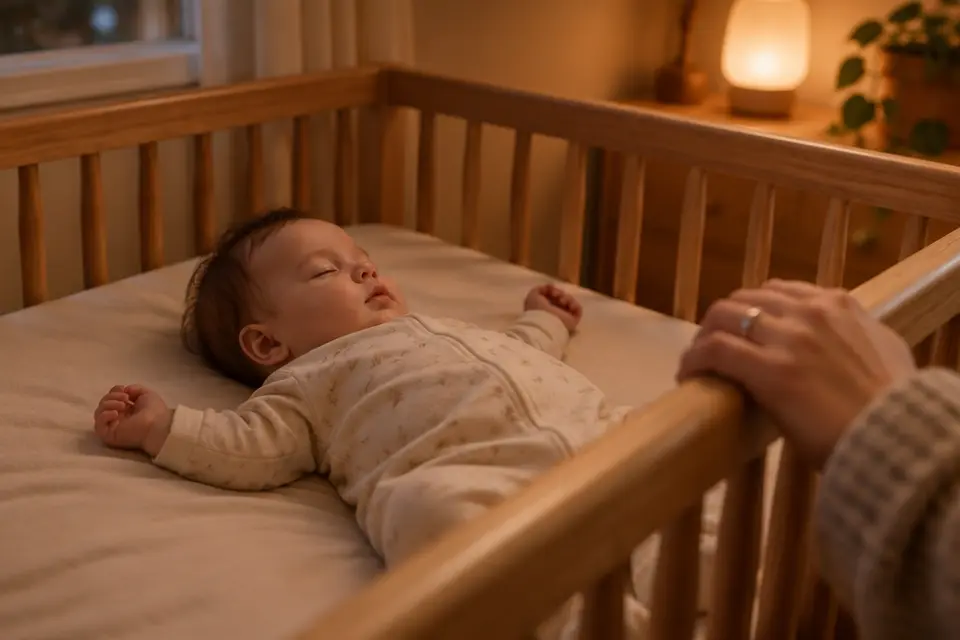
What is sudden infant death syndrome?
According to the INSPQ, sudden infant death syndrome (SIDS) is the sudden death of a baby under one year during sleep, with no known cause. Several factors that raise or lower the risk are known, though.
Risk factors include exposure to tobacco smoke during pregnancy or after birth, sleeping on the tummy and having the head covered by bedding. A baby used to sleeping on the back who is put down on the tummy once is at higher risk. Breastfeeding and up-to-date vaccines lower the risk.
The basics of safe sleep
Based on the INSPQ, Health Canada and the Public Health Agency of Canada:
- on the back, from birth, for every sleep, naps included;
- on a firm, flat mattress, in a crib, cradle or bassinet that meets Canadian standards;
- a fitted sheet only: no pillow, duvet, bumper pad, nest or stuffed toy;
- in their own bed, in the parents’ room, for the first six months;
- a light blanket or a sleep sack in the right size, without overheating;
- a smoke-free home and car;
- once they roll over alone, you can leave them in the position they take.
Bed sharing: what the INSPQ says
The INSPQ recommends that babies sleep in their own bed. It also says never to share a sofa or armchair with a baby to sleep, and not to share a bed if an adult has had alcohol, taken medication that causes drowsiness or drugs, or is unusually exhausted.
For parents who share a bed anyway, the INSPQ says the baby should sleep on their back on a firm mattress, with no pillow or duvet nearby, no gap between the mattress and the wall, and never be left alone in an adult bed.
Car seats, strollers, carriers and playpens
A car seat is for car travel and does not replace a crib. In a stroller, the baby lies on their back, with the seat flat or nearly flat, and buckled in. A baby carrier is not safe if the adult wearing it falls asleep or rests lying down.
For a baby under six months, the INSPQ mentions that a playpen or a floor mattress can be a temporary sleep spot, with no added padding. Breathing monitors do not replace any of these precautions.
Preventing a flat head
Back sleeping can flatten the back of the head. The INSPQ suggests supervised tummy time while awake and alternating, each day, the side your baby’s head faces in the crib.
In an emergency, call 911. For any other question about sleep, your health line can help (Info-Santé 811 in Québec answers day and night).
What is worth logging in Maliah
In Maliah, a sleep is logged with a tap or by voice, with the time and the name of whoever logged it. Your partner, the grandparents or the babysitter see the last sleep and the last feed without texting, and the summary over a few weeks can be shown to the doctor or nurse. Safe sleep guidelines can be passed on to the babysitter with the site’s babysitter sheet.
Frequently asked questions
How long should a baby sleep in the parents’ room?
The Canadian Paediatric Society and Health Canada recommend the first six months, in the baby’s own bed.
My baby rolls onto their tummy at night. Should I turn them back?
According to the INSPQ, once a baby rolls over alone, you can leave them in the position they take. Keep putting them down on their back.
Can a baby sleep in the car seat?
A car seat is for travel. Once you arrive, the INSPQ recommends moving the baby to a firm, flat surface, on their back.
Is bed sharing dangerous?
The INSPQ recommends a separate bed in the parents’ room and lists situations where sharing a bed must be avoided: sofa, alcohol, medication or drugs, extreme tiredness.
Read next
- Newborn sleep schedule: what to expect in the first weeks
- 6 month old sleep schedule
- White noise for babies: using it without risking hearing
Related free tools
Other guides
Sources : INSPQ, Mieux vivre : Dormir en sécurité · INSPQ, Mieux vivre : Mort subite du nourrisson · INSPQ, Mieux vivre : Prévention de la tête plate · INSPQ, Mieux vivre : Sommeil dans les premières semaines de vie · INSPQ, Mieux vivre : Sommeil autour de l’âge de 4 mois · INSPQ, Mieux vivre : Sommeil après 6 mois · INSPQ, Mieux vivre : Sommeil entre 1 et 2 ans · Société canadienne de pédiatrie, Caring for Kids : Healthy sleep for your baby and child · Directives canadiennes en matière de mouvement sur 24 heures pour la petite enfance (0 à 4 ans) · Agence de la santé publique du Canada : Sommeil sécuritaire · Santé Canada : Votre enfant est-il en sécurité ? L’heure du coucher · American Academy of Pediatrics, HealthyChildren.org : Getting your baby to sleep · Pediatrics (AAP), 2014 : Infant sleep machines and hazardous sound pressure levels · CDC, Learn the Signs. Act Early : étapes du développement · 811 Nouvelle-Écosse : Pleurs de bébé avant l’âge d’un an · Québec.ca : Info-Santé 811
Worried about your child’s health or your pregnancy? In Québec, Info-Santé 811 answers day and night; elsewhere, call your local health line. In an emergency, call 911. This article is for information; it does not replace advice from a health professional. In Québec, call Info-Santé 811 when in doubt (elsewhere in Canada, your provincial health line). In an emergency, call 911. Updated on November 7, 2026.