Prenatal care
Gestational diabetes: what it is, screening and follow-up
Gestational diabetes is high blood sugar that appears during pregnancy. In Québec, screening is offered between 24 and 28 weeks. Here is how the test works and what follow-up looks like if you are diagnosed.
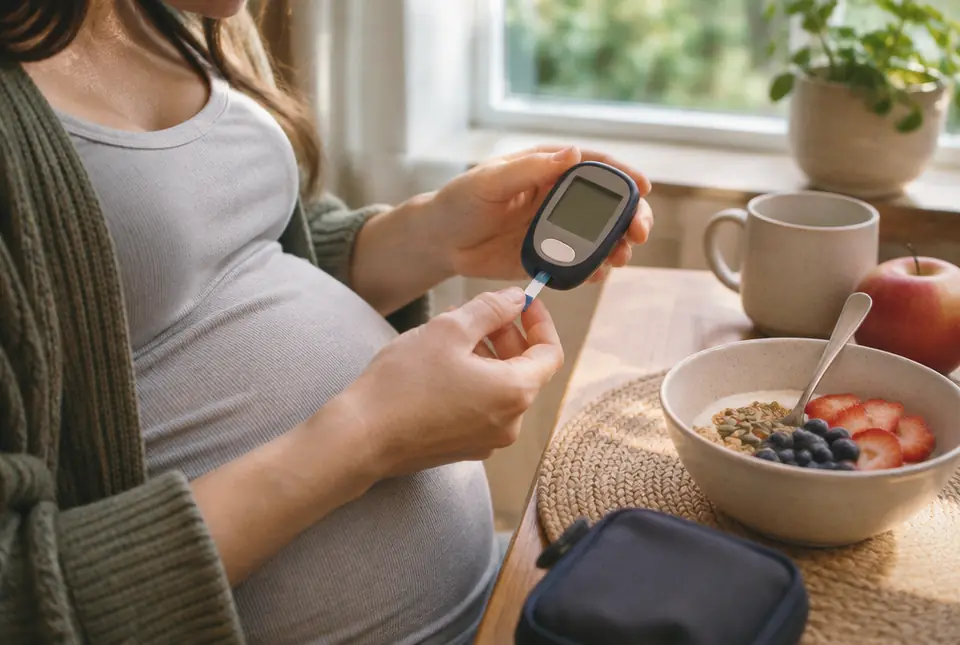
What is gestational diabetes?
Gestational diabetes is blood sugar (glucose) that is too high and appears during pregnancy. According to Québec’s public health institute (INSPQ), hormones made by the placenta contribute to it. It is one of the situations where pregnancy is followed more closely. It usually causes no symptoms, which is why screening matters.
When and how is screening done?
In Québec, a screening test is offered between 24 and 28 weeks of pregnancy. You drink a sugary drink, then a blood test measures your blood sugar after a set time. Depending on the result, a second, longer test may be requested. Your provider tells you how to prepare and explains the result; this page gives no target values.
If you are diagnosed with gestational diabetes
Your team will refer you, often to a specialized clinic. According to the INSPQ, care relies first on:
- balanced eating and regular meal times, with a session with a dietitian, alone or in a group;
- regular physical activity, such as a daily walk;
- regular blood sugar checks, following your team’s instructions;
- treatment prescribed by the team if blood sugar stays poorly controlled despite diet and exercise.
Why does this follow-up matter?
Poorly controlled gestational diabetes can lead to a larger baby, which can make the birth more difficult or lead to a caesarean. At birth, the baby may have low blood sugar or trouble breathing, and will be monitored. Late in pregnancy, extra tests of the baby’s well-being and monitoring during labour may be offered.
After the birth
Gestational diabetes usually goes away after the birth, but your provider will discuss follow-up, because it calls for keeping an eye on blood sugar in the years that follow. In Québec, Diabète Québec’s InfoDiabète line also answers questions.
What is worth tracking in Maliah
Maliah only offers blood sugar tracking if you indicate gestational diabetes. Readings are logged with the time and the meal, by voice or in two taps, and the chart can be shared with the clinic. The app calculates no doses and sets no targets: those are your team’s.
Frequently asked questions
When is the gestational diabetes test done?
In Québec, it is offered between 24 and 28 weeks of pregnancy.
What happens during the glucose screening test?
You drink a sugary drink, then a blood test measures your blood sugar. Your provider gives you the instructions.
Is gestational diabetes dangerous for the baby?
Poorly controlled, it can lead to a larger baby and low blood sugar at birth. With good follow-up, these risks go down.
Does gestational diabetes go away after birth?
Usually yes, but follow-up is recommended afterwards; your provider will discuss it with you.
Read next
- Prenatal care in Québec: visits, tests and timeline
- Foods to avoid during pregnancy: Health Canada’s list
- Exercise during pregnancy: what, how much and when to stop
- Pregnancy weight gain: Health Canada’s ranges
Related free tools
Other guides
Sources : INSPQ, Mieux vivre : Malaises de grossesse · INSPQ, Mieux vivre : Changements physiques pendant la grossesse · INSPQ, Mieux vivre : Signaux d’alarme pendant la grossesse · INSPQ, Mieux vivre : Suivi de grossesse · INSPQ, Mieux vivre : Grossesse à risque élevé (diabète de grossesse) · INSPQ, Mieux vivre : Reconnaître le début du travail · INSPQ, Mieux vivre : Les boissons pendant la grossesse (caféine, tisanes, eau) · INSPQ, Mieux vivre : Activités physiques pendant la grossesse · INSPQ, Mieux vivre : Sexualité pendant la grossesse · INSPQ, Mieux vivre : Médicaments et produits de santé naturels pendant la grossesse · INSPQ, Information périnatale : Santé mentale, ressources et liens utiles · INSPQ : Mieux vivre avec notre enfant de la grossesse à deux ans (guide 2026) · Québec.ca : Dépistage et offre de tests (Programme québécois de dépistage prénatal) · Santé Canada : Manipulation sécuritaire des aliments pour les personnes enceintes (2024) · Santé Canada : La caféine dans les aliments · Santé Canada : Calculateur du gain de poids pendant la grossesse · Santé Canada : Lignes directrices sur le gain de poids gestationnel · Agence de la santé publique du Canada : Guide pour une grossesse en santé · SOGC et SCPE : Lignes directrices canadiennes 2019 sur l’activité physique pendant la grossesse · Gouvernement du Canada : 9-8-8, ligne d’aide en cas de crise de suicide
Worried about your child’s health or your pregnancy? In Québec, Info-Santé 811 answers day and night; elsewhere, call your local health line. In an emergency, call 911. This article is for information; it does not replace advice from a health professional. In Québec, call Info-Santé 811 when in doubt (elsewhere in Canada, your provincial health line). In an emergency, call 911. Updated on November 7, 2026.