Month by month
18 month old milestones
At eighteen months, your child walks alone, says at least three words, scribbles and copies you doing chores. Here are the milestones for this age, play ideas and when to talk to the doctor.
What does an 18 month old do?
Eighteen months is a checkpoint on the CDC “Learn the Signs. Act Early” checklist. Your child wanders off to explore while checking that you are there, understands directions without gestures, and starts doing things “like the grown-ups”. In Québec, it is also the age of the enhanced vaccination visit, where a nurse discusses your child’s development.
Movement at 18 months
They walk without holding on, scribble, drink from a cup without a lid and may spill, feed themselves with their fingers and try to use a spoon. They climb on and off a couch or chair without help.
- Walks without holding on.
- Scribbles.
- Drinks from a cup without a lid, sometimes spilling.
- Feeds themselves with fingers and tries to use a spoon.
- Climbs on and off a couch or chair without help.
Language and communication
They try to say three or more words besides “mama” or “dada” and follow one-step directions without gestures, like giving you the toy when you say “Give it to me.” According to the INSPQ, they also copy animal sounds.
- Tries to say three or more words besides “mama” or “dada”.
- Follows one-step directions without gestures.
Feelings and learning
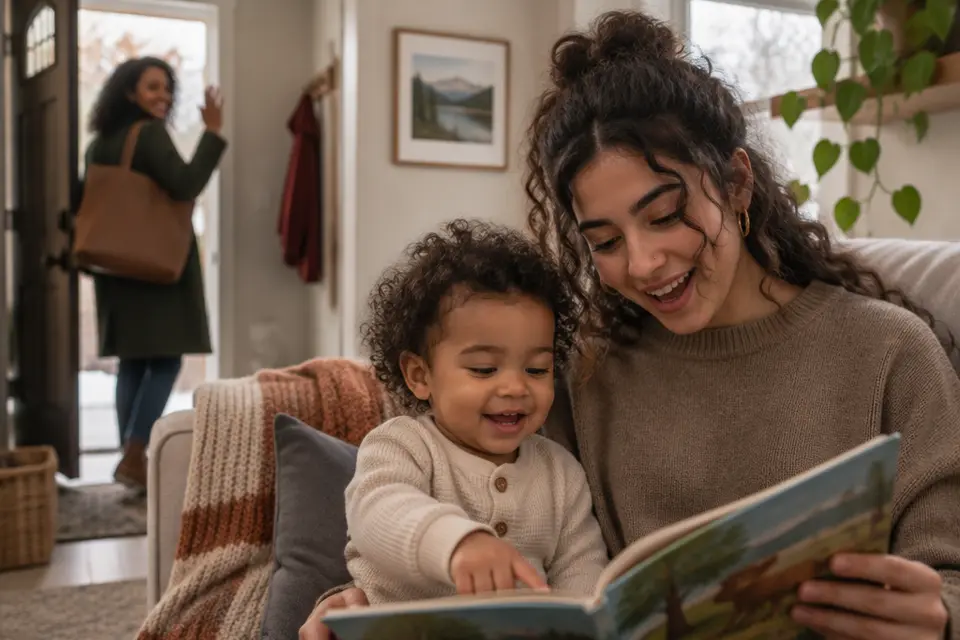
They move away from you but look to make sure you are close. They point to show you something interesting, put their hands out for washing, look at a few pages of a book with you and help with dressing by pushing an arm through a sleeve. They copy you doing chores, like sweeping, and play with toys in simple ways, like pushing a car.
- Moves away but checks you are close.
- Points to show you something.
- Looks at a few pages of a book with you.
- Helps with dressing.
- Copies you doing chores.
- Plays with toys simply (pushes a car).
How to play with an 18 month old
According to the INSPQ, around eighteen months, copying games and early pretend play are worth encouraging.
- Let them “help”: sweeping, sorting socks, wiping the table.
- Offer a doll or stuffed toy to feed and put to bed.
- Provide push or pull toys.
- Look for pictures in books: “Where’s the cat?”
- Add a word to what they say: “Car!” “Yes, the red car.”
When should you talk to a professional?
In Québec, a short questionnaire can help you prepare for the eighteen-month vaccination visit. Write down what your child says and does, and your questions.
Every child develops at their own pace, and these milestones describe what about three in four children do by this age. If your child is not doing one or more of them yet, loses a skill they had, or something worries you, don’t wait: talk to their doctor or nurse. In Québec, your CLSC access desk can also register your child for an Agir tôt screening without a referral, and Info-Santé 811 answers questions. For a baby born preterm, use the corrected age.
What is worth noting in Maliah
Before the eighteen-month visit, the list of words and gestures noted in Maliah, with their dates, saves you from counting from memory.
In Maliah, feeds, sleep and diapers are logged in two taps or by voice, and the whole family sees the same entries, each with its author and time. Before an appointment, the summary for the doctor gathers what was noted since the last visit.
Frequently asked questions
What should an 18 month old be doing?
According to the CDC, most eighteen-month-olds walk alone, scribble, try to use a spoon, say three or more words, follow one-step directions without gestures and copy you doing chores.
My 18 month old doesn’t talk much. What should I do?
If your child does not say at least three words besides “mama” or “dada”, or you are worried, don’t wait: talk to their doctor or your CLSC, which can do an Agir tôt screening without a referral.
What is the 18-month vaccination visit in Québec?
According to the INSPQ, all children in Québec can have an enhanced vaccination visit with a nurse around eighteen months to discuss their development.
My 18 month old won’t share toys. Is that normal?
Yes. According to the INSPQ, between fifteen and eighteen months children begin to play alongside others but do not share yet.
Read next
Related free tools
Other guides
Sources : CDC, Learn the Signs. Act Early : listes de repères (révision 2022) · CDC : 2 months · CDC : 4 months · CDC : 6 months · CDC : 9 months · CDC : 1 year · CDC : 15 months · CDC : 18 months · CDC : 2 years · CDC : 3 years · CDC : 4 years · CDC : 5 years · INSPQ, Mieux vivre : Étapes du développement de l’enfant · INSPQ, Mieux vivre : Activités pour soutenir le développement de l’enfant · INSPQ, Mieux vivre : Vous avez des questions sur le développement de votre enfant ? · INSPQ, Mieux vivre : Apprentissage de la propreté · INSPQ, Mieux vivre : Dents de bébé · INSPQ, Mieux vivre : Prévention de la tête plate · Société canadienne de pédiatrie, Soins de nos enfants : Toilet learning · Santé Canada : produits de consommation interdits au Canada (dont les marchettes pour bébés) · Québec.ca : Dépistage de la surdité chez les nouveau-nés
Worried about your child’s health or your pregnancy? In Québec, Info-Santé 811 answers day and night; elsewhere, call your local health line. In an emergency, call 911. This article is for information; it does not replace advice from a health professional. In Québec, call Info-Santé 811 when in doubt (elsewhere in Canada, your provincial health line). In an emergency, call 911. Updated on November 7, 2026.