Ages 1 to 5
2 year old milestones
At two, your child runs, kicks a ball, says little two-word phrases and starts to pretend. Here are the milestones for this age and how to support your toddler’s development day to day.
What does a 2 year old do?
Two years is a checkpoint on the CDC “Learn the Signs. Act Early” checklist. According to the INSPQ, between eighteen and twenty-four months children want to do things alone, discover new feelings like pride and jealousy, start pretend play and recognize themselves in the mirror. Tantrums are common too: they have a lot to say and few words to say it.
Movement at 2 years
They run, kick a ball, walk (not climb) up a few stairs with or without help, and eat with a spoon. According to the INSPQ, they begin to jump with both feet around twenty-four months and can undress on their own.
- Kicks a ball.
- Runs.
- Walks up a few stairs, with or without help.
- Eats with a spoon.
Language: first phrases
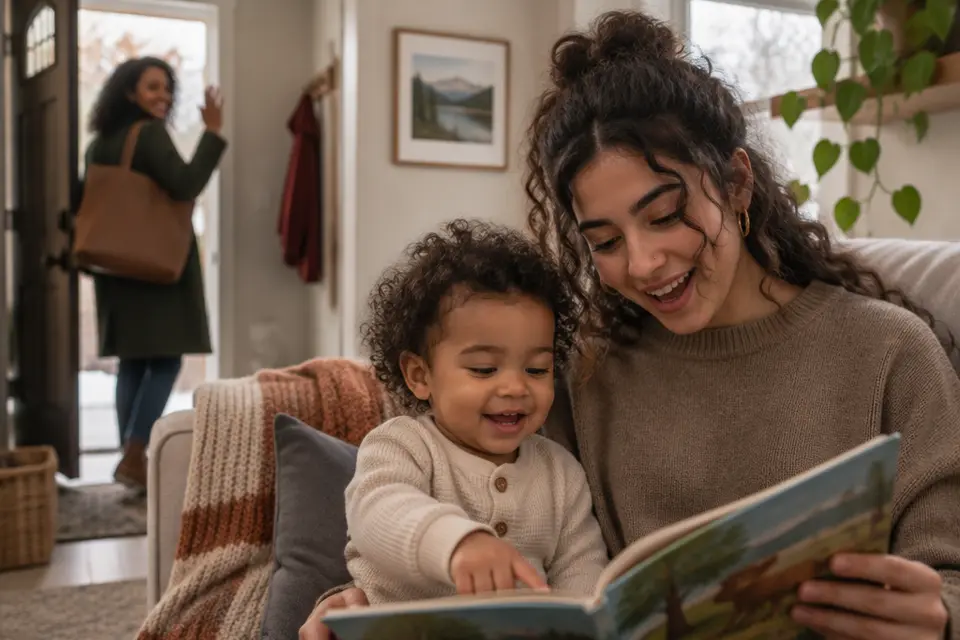
They say at least two words together, like “More milk.” They point to things in a book when you ask “Where’s the bear?”, point to at least two body parts and use gestures beyond waving and pointing, like blowing a kiss or nodding yes.
- Says at least two words together.
- Points to things in a book when asked.
- Points to at least two body parts.
- Uses more gestures (blowing a kiss, nodding yes).
Feelings and learning
They notice when others are hurt or upset and look at your face to see how to react in a new situation. They hold something in one hand while using the other, try switches and buttons on toys, and play with more than one toy at once, like putting toy food on a plate. Sharing is still hard, and that is normal.
- Notices when others are hurt or upset.
- Looks at your face in a new situation.
- Uses both hands in different ways.
- Tries switches, knobs or buttons on toys.
- Plays with more than one toy at the same time.
How to support a 2 year old
Toddlers learn through play, repetition and imitation. Simple, predictable limits help them manage big feelings.
- Offer push and pull toys and wooden puzzles.
- Read together and ask simple questions about the pictures.
- Name their feelings: “You’re angry because the game is over.”
- Offer two acceptable choices instead of an order.
- Play pretend: tea party, doll, toy phone.
When should you talk to a professional?
According to the CDC, it is worth raising if your two-year-old is not yet putting two words together. In Québec, the CLSC can do an Agir tôt screening without a referral.
Every child develops at their own pace, and these milestones describe what about three in four children do by this age. If your child is not doing one or more of them yet, loses a skill they had, or something worries you, don’t wait: talk to their doctor or nurse. In Québec, your CLSC access desk can also register your child for an Agir tôt screening without a referral, and Info-Santé 811 answers questions. For a baby born preterm, use the corrected age.
What is worth noting in Maliah
At two, many families start thinking about potty training. Logging a few days of dry or wet diapers gives a concrete idea of where your child is.
In Maliah, every family member can log sleep, a meal, an appointment or an observation in two taps or by voice, and everyone sees the same entries, each with its author and time. Before a visit, the summary for the doctor gathers what was noted.
Frequently asked questions
What should a 2 year old be doing?
According to the CDC, most two-year-olds run, kick a ball, eat with a spoon, say two words together, point to body parts and play with more than one toy at a time.
How many words should a 2 year old say?
The CDC checklist does not set a word count at two; the milestone is saying at least two words together, like “More milk.” According to the INSPQ, two-word phrases arrive around twenty-four months.
Why does my 2 year old have tantrums?
According to the INSPQ, between eighteen and twenty-four months children want to do things alone, feel new emotions and may hit or bite. Stay calm, name the feeling and set a clear limit.
My 2 year old won’t share. Is that normal?
Yes. According to the INSPQ, sharing is still hard at this age. They will learn gradually, with your example and lots of repetition.
Read next
- 18 month old milestones
- 3 year old milestones
- Potty training: when is your child ready?
- When do babies start talking?
Related free tools
Other guides
Sources : CDC, Learn the Signs. Act Early : listes de repères (révision 2022) · CDC : 2 months · CDC : 4 months · CDC : 6 months · CDC : 9 months · CDC : 1 year · CDC : 15 months · CDC : 18 months · CDC : 2 years · CDC : 3 years · CDC : 4 years · CDC : 5 years · INSPQ, Mieux vivre : Étapes du développement de l’enfant · INSPQ, Mieux vivre : Activités pour soutenir le développement de l’enfant · INSPQ, Mieux vivre : Vous avez des questions sur le développement de votre enfant ? · INSPQ, Mieux vivre : Apprentissage de la propreté · INSPQ, Mieux vivre : Dents de bébé · INSPQ, Mieux vivre : Prévention de la tête plate · Société canadienne de pédiatrie, Soins de nos enfants : Toilet learning · Santé Canada : produits de consommation interdits au Canada (dont les marchettes pour bébés) · Québec.ca : Dépistage de la surdité chez les nouveau-nés
Worried about your child’s health or your pregnancy? In Québec, Info-Santé 811 answers day and night; elsewhere, call your local health line. In an emergency, call 911. This article is for information; it does not replace advice from a health professional. In Québec, call Info-Santé 811 when in doubt (elsewhere in Canada, your provincial health line). In an emergency, call 911. Updated on November 7, 2026.