Feeding schedule by age
18 month old feeding schedule: meals, appetite and independence
Around 18 months, toddlers’ appetite often drops and they want to feed themselves. That’s normal. Here are Health Canada, Canadian Paediatric Society and INSPQ markers for meals, milk and safety.
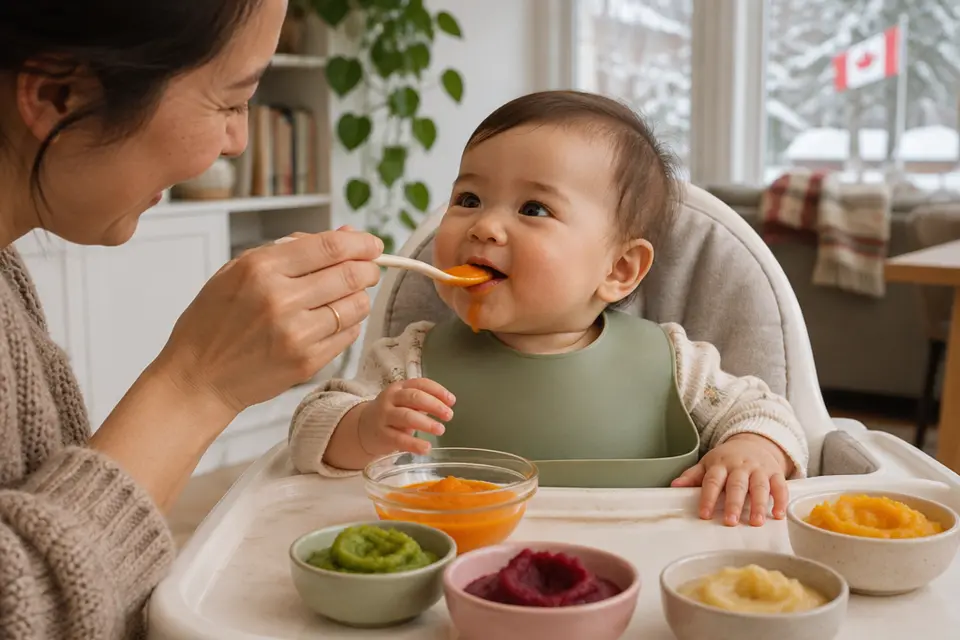
Why is my 18 month old eating less?
Growth slows after the first year, and the Canadian Paediatric Society notes that appetite may decrease between 18 and 24 months. Toddlers may also refuse foods they used to love. Your job is to offer varied foods at regular times; theirs is to decide how much to eat. Pressuring or rewarding with dessert often makes meals harder.
How many meals and snacks at 18 months?
Three meals and two or three snacks at fairly regular times suit most toddlers. Snacks are small nutritious meals, not treats: fruit, vegetables, yogurt, cheese, whole grain cereal.
- One accepted food at each meal, next to a new one.
- Small portions, with seconds if wanted.
- Water in a cup for thirst.
- Family meals without screens whenever possible.
Ending the bottle and the place of milk
Health Canada recommends that the move from bottle to open cup be complete by about 18 months. For a child who isn’t breastfed, about 500 mL of homogenized cow’s milk a day is enough, and no more than 750 mL. Breastfeeding can continue to two years and beyond, as you and your child choose.
Self-feeding, safely
At 18 months, toddlers love eating with their hands, trying the spoon and tasting different textures. Let them. The INSPQ safety rules apply until age four: children eat sitting down, supervised by an adult, never while walking or in the car. Fresh grapes are cut into quarters, hard raw vegetables grated, and whole nuts, popcorn and hard candy avoided.
Example day (adapt to your child)
This example only shows one way to organize the day.
- Breakfast: oatmeal, cut-up fruit; milk in a cup.
- Snack: plain yogurt.
- Lunch: rice, black beans, cooked vegetables, cheese; water.
- Snack: cooked or grated apple, crackers.
- Supper: small pieces of chicken, potatoes, vegetables; milk in a cup.
What is worth noting in Maliah
When appetite swings a lot, seeing a whole week of meals is more reassuring than a single day. In Maliah, a feed, a meal or a diaper is logged in two taps or by voice, with the time and the name of whoever logged it. The whole family sees the same log, and a summary of the last few days is ready for the visit with the doctor or nurse.
Frequently asked questions
My 18 month old barely eats: is that normal?
A drop in appetite is common around this age. If your child seems unwell, loses weight or you are worried, talk to your doctor or call a health line such as 811.
Can an 18 month old still use a bottle?
Health Canada recommends completing the switch to an open cup by about 18 months.
What foods should an 18 month old avoid?
Hard, small, round or sticky foods remain a choking risk until age four: whole nuts, popcorn, hard candy, whole grapes.
Can I give 2% milk at 18 months?
Health Canada doesn’t routinely recommend skim, 1% or 2% milk before age two.
Read next
- 12 month old feeding schedule: meals, milk and the open cup
- 2 year old feeding schedule: meals, milk and new foods
- Weaning from breastfeeding: when and how to stop gently
- Gagging vs choking in babies: how to tell the difference
Related free tools
Other guides
Sources : INSPQ : Mieux vivre avec notre enfant de la grossesse à deux ans (guide 2026) · INSPQ, Mieux vivre : Quand introduire les aliments ? · INSPQ, Mieux vivre : Comment introduire les aliments ? · INSPQ, Mieux vivre : Diversification alimentaire menée par l’enfant (DME) · INSPQ, Mieux vivre : Risques d’étouffement, à surveiller jusqu’à 4 ans · INSPQ, Mieux vivre : Allergies alimentaires chez l’enfant · INSPQ, Mieux vivre : Bases d’une tétée · INSPQ, Mieux vivre : Manipulation du lait exprimé · INSPQ, Mieux vivre : Tiédir le lait · INSPQ, Mieux vivre : Sevrage de l’allaitement · INSPQ, Mieux vivre : Rots, régurgitations, hoquet et gaz · Santé Canada : Nutrition du nourrisson né à terme et en santé, de 6 à 24 mois · Santé Canada : Nutrition du nourrisson né à terme et en santé, de la naissance à 6 mois · Santé Canada : Allergies alimentaires (allergènes prioritaires) · Santé Canada : Le mercure dans le poisson · Société canadienne de pédiatrie (Soins de nos enfants) : Nourrir votre bébé pendant la première année · Guide alimentaire canadien · Organisation mondiale de la santé : Allaitement
Worried about your child’s health or your pregnancy? In Québec, Info-Santé 811 answers day and night; elsewhere, call your local health line. In an emergency, call 911. This article is for information; it does not replace advice from a health professional. In Québec, call Info-Santé 811 when in doubt (elsewhere in Canada, your provincial health line). In an emergency, call 911. Updated on November 7, 2026.