When can babies eat…
When can babies eat baby cereal?
Iron-fortified infant cereal is one of the first foods recommended around six months. Here is how to prepare it, why to choose iron-fortified cereal and why it never goes in the bottle, according to the INSPQ and Health Canada.
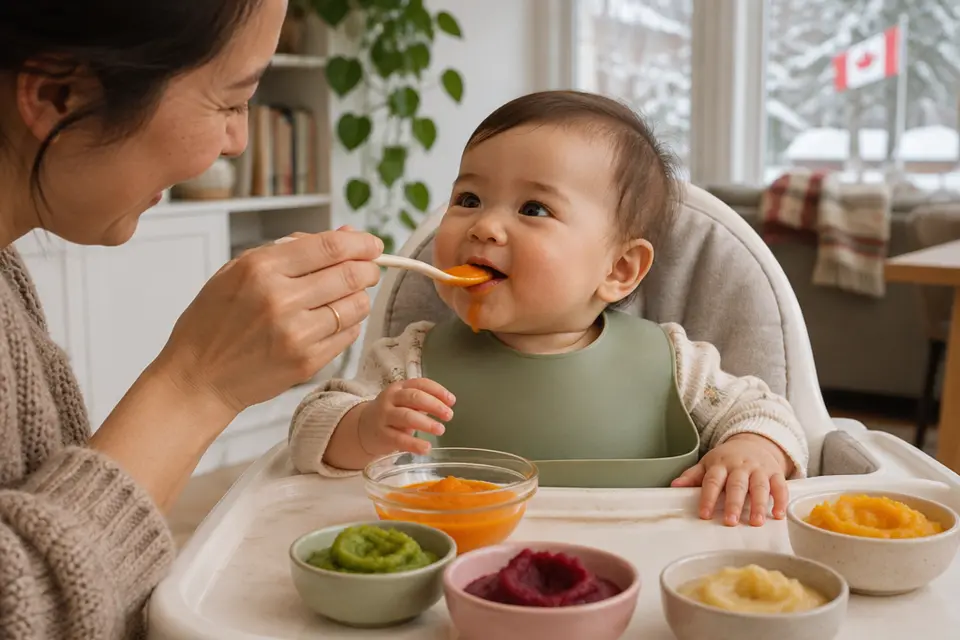
At what age can babies have cereal?
Around six months, when your baby shows they are ready to eat. Health Canada and the Canadian Paediatric Society list iron-fortified infant cereal among the first iron-rich foods, with meat, fish, egg, tofu and legumes. Before four months, the digestive system isn’t ready, the INSPQ reminds, and cereal doesn’t help babies sleep through the night.
Why iron-fortified cereal?
Around six months, a baby’s iron stores drop. Infant cereals are fortified with iron, unlike most adult breakfast cereals. They mix easily with your baby’s milk, giving a familiar taste. Vary the grains: oat, barley, wheat, multigrain; wheat is a priority allergen worth introducing early.
How to prepare baby cereal by age
Follow the package directions, then adjust the texture for your baby.
- Around 6 months: cereal mixed with breast milk, formula or water, fairly thin at first, then thicker.
- Around 6 months, baby-led: thick cereal on a preloaded spoon, or used to coat slippery pieces.
- 7 to 12 months: thicker cereal mixed with mashed fruit, plain yogurt or thinned peanut butter.
- Always by spoon or fingers, never in the bottle.
Why no cereal in the bottle?
Cereal is a food: it is given by spoon or fingers, when your baby is seated and ready to eat. In a bottle, it doesn’t teach your baby to eat or to recognize hunger. The INSPQ notes that sleep depends on a baby’s biological rhythm and temperament, not cereal at supper. If your baby never seems satisfied, talk to your nurse, doctor or a health line.
What is worth noting in Maliah
Logging the day’s iron-rich meals helps check they are offered at least twice a day. In Maliah, a feed, a meal or a diaper is logged in two taps or by voice, with the time and the name of whoever logged it. The whole family sees the same log, and a summary of the last few days is ready for the visit with the doctor or nurse.
Frequently asked questions
Can I put cereal in the bottle to help my baby sleep?
No. The INSPQ says cereal doesn’t help babies sleep through the night, and it’s given by spoon.
Which cereal should I start with?
An iron-fortified infant cereal. The grain order matters little; varying helps introduce wheat early.
What do I mix baby cereal with?
Breast milk, commercial formula or water, as the package says. After 9 to 12 months, cow’s milk can also be used.
How often should I offer iron-fortified cereal?
There is no set number. Health Canada recommends iron-rich foods at least twice a day; cereal can be one of them, alternating with meat, egg, tofu or legumes.
Read next
- 6 month old feeding schedule: how to start solid foods
- Starting solids: when and how to begin with your baby
- When can babies eat wheat: bread, pasta and cereal?
- Baby food purées: where to start and how to move on
Related free tools
Other guides
Sources : INSPQ : Mieux vivre avec notre enfant de la grossesse à deux ans (guide 2026) · INSPQ, Mieux vivre : Quand introduire les aliments ? · INSPQ, Mieux vivre : Comment introduire les aliments ? · INSPQ, Mieux vivre : Diversification alimentaire menée par l’enfant (DME) · INSPQ, Mieux vivre : Risques d’étouffement, à surveiller jusqu’à 4 ans · INSPQ, Mieux vivre : Allergies alimentaires chez l’enfant · INSPQ, Mieux vivre : Bases d’une tétée · INSPQ, Mieux vivre : Manipulation du lait exprimé · INSPQ, Mieux vivre : Tiédir le lait · INSPQ, Mieux vivre : Sevrage de l’allaitement · INSPQ, Mieux vivre : Rots, régurgitations, hoquet et gaz · Santé Canada : Nutrition du nourrisson né à terme et en santé, de 6 à 24 mois · Santé Canada : Nutrition du nourrisson né à terme et en santé, de la naissance à 6 mois · Santé Canada : Allergies alimentaires (allergènes prioritaires) · Santé Canada : Le mercure dans le poisson · Société canadienne de pédiatrie (Soins de nos enfants) : Nourrir votre bébé pendant la première année · Guide alimentaire canadien · Organisation mondiale de la santé : Allaitement
Worried about your child’s health or your pregnancy? In Québec, Info-Santé 811 answers day and night; elsewhere, call your local health line. In an emergency, call 911. This article is for information; it does not replace advice from a health professional. In Québec, call Info-Santé 811 when in doubt (elsewhere in Canada, your provincial health line). In an emergency, call 911. Updated on November 7, 2026.