Sleep regressions
4 month sleep regression: what is really going on
Your baby was sleeping better, and suddenly wakes more often around four months. What parents call the “4 month sleep regression” matches a real change in baby sleep that the INSPQ describes.
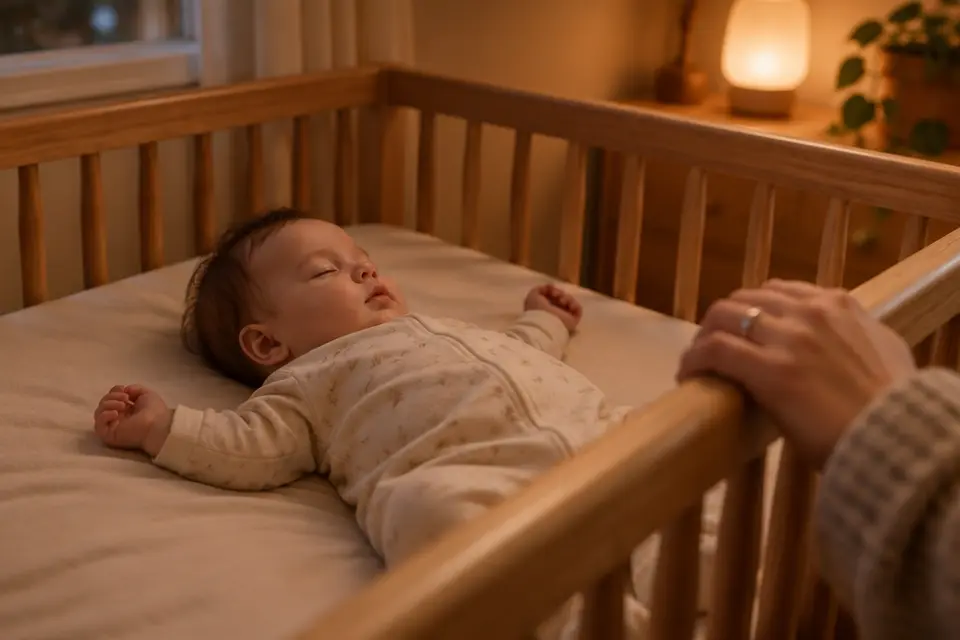
What is the 4 month sleep regression?
“Sleep regression” is not a medical term: it does not appear in INSPQ or Canadian Paediatric Society guidance. It is the name parents give to a stretch when a child who was sleeping fairly well starts waking again, fighting naps or crying at bedtime.
Around four months, it often shows up as more frequent wakings, shorter naps and a baby who needs help falling back asleep when they sometimes managed without.
Why does sleep change around 4 months?
The INSPQ describes this age as a turning point: total sleep drops to about 14 to 15 hours a day, nights get longer and the schedule becomes more predictable. The American Academy of Pediatrics also places the arrival of regular sleep cycles around 4 months.
Between two cycles, babies pass through lighter sleep where they may wake. If they fell asleep at the breast, with a bottle or in your arms, they often look for the same conditions to fall back asleep. Some babies also still need night feeds, sometimes more than before, according to the INSPQ.
How long does the 4 month sleep regression last?
No official source measures how long a “regression” lasts. Parents most often describe it as a few weeks, fading as the child masters the new stage. If the difficulties last for months, it is no longer just a passing phase, and it is worth talking to a health professional.
At four months, part of this change is lasting: sleep has reorganized. What passes is mostly the adjustment period.
What helps?
No method is required: the INSPQ points out that there is no right or wrong way, and that the approach should suit you. A few ideas drawn from the sources:
- a short, identical routine every evening that signals sleep;
- calm night feeds in dim light, with no play or long chats;
- putting your baby down drowsy but awake, if you want them to learn to fall asleep alone (American Academy of Pediatrics);
- waiting a few moments before stepping in, since a baby in active sleep may settle on their own;
- a night-light in the hallway and a door left ajar, the INSPQ suggests;
- taking turns between adults, at night as well as by day.
When to call 811 or see a health professional
A regression is not an illness. But a four month old who wakes more may also be sick, hungry or uncomfortable.
Official sources give a few markers for asking advice from your doctor, nurse or local health line (Info-Santé 811 in Québec):
- your baby cries a lot at night: the INSPQ suggests first checking whether they are sick;
- wakings continue despite a routine and worry you, or you cannot set up a routine (INSPQ);
- your child snores loudly, seems to gasp or stops breathing for moments during sleep (Canadian Paediatric Society);
- you are at the end of your rope: health lines also support exhausted parents (Info-Social 811 in Québec);
- in an emergency, such as trouble breathing, call 911.
What is worth logging in Maliah
In Maliah, a sleep is logged with a tap or by voice, with the time and the name of whoever logged it. Your partner, the grandparents or the babysitter see the last sleep and the last feed without texting, and the summary over a few weeks can be shown to the doctor or nurse. During a regression, logging night wakings and feeds helps you see whether things are improving week by week, beyond the tiredness of the moment.
Frequently asked questions
Is the 4 month sleep regression real?
The term is not medical, but the change is: the INSPQ describes sleep reorganizing around four months, with longer nights and a steadier schedule, which sometimes comes with a period of wakings.
How long does the 4 month sleep regression last?
No official source measures it; parents most often describe a few weeks. If difficulties last for months, talk to your doctor or nurse.
Should I start sleep training during the 4 month regression?
It is not required. The INSPQ says there is no single right approach: some parents rock their baby, others prefer teaching them to fall asleep alone. The choice is yours.
My 4 month old wakes every hour. Is that normal?
More frequent wakings are common at this age. If your baby seems sick, cries a lot or you are worried, call your doctor or health line (811 in Québec).
Read next
- 4 month old sleep schedule
- Baby night wakings: why babies wake and what helps
- Baby wake windows: a useful guide, not a rule
Related free tools
Other guides
Sources : INSPQ, Mieux vivre : Dormir en sécurité · INSPQ, Mieux vivre : Mort subite du nourrisson · INSPQ, Mieux vivre : Prévention de la tête plate · INSPQ, Mieux vivre : Sommeil dans les premières semaines de vie · INSPQ, Mieux vivre : Sommeil autour de l’âge de 4 mois · INSPQ, Mieux vivre : Sommeil après 6 mois · INSPQ, Mieux vivre : Sommeil entre 1 et 2 ans · Société canadienne de pédiatrie, Caring for Kids : Healthy sleep for your baby and child · Directives canadiennes en matière de mouvement sur 24 heures pour la petite enfance (0 à 4 ans) · Agence de la santé publique du Canada : Sommeil sécuritaire · Santé Canada : Votre enfant est-il en sécurité ? L’heure du coucher · American Academy of Pediatrics, HealthyChildren.org : Getting your baby to sleep · Pediatrics (AAP), 2014 : Infant sleep machines and hazardous sound pressure levels · CDC, Learn the Signs. Act Early : étapes du développement · 811 Nouvelle-Écosse : Pleurs de bébé avant l’âge d’un an · Québec.ca : Info-Santé 811
Worried about your child’s health or your pregnancy? In Québec, Info-Santé 811 answers day and night; elsewhere, call your local health line. In an emergency, call 911. This article is for information; it does not replace advice from a health professional. In Québec, call Info-Santé 811 when in doubt (elsewhere in Canada, your provincial health line). In an emergency, call 911. Updated on November 7, 2026.